Tampilkan postingan dengan label thanks. Tampilkan semua postingan

Senin, 21 Maret 2016

Small Boat Plans And Kits


THE WAY OF A SHIP in the sea is not as great a mystery as the Bible makes it out to be. Most of us can understand that a boat left to its own resources in heavy seas will tend to adopt a position that’s roughly broadside on to the wind.

Most keelboats will settle that way, and be quite happy, when all sail is taken down. Often, there’s a tendency, especially with sloops, for the bow to drift downwind a bit, which causes the hull to gather way and forereach. You can counteract that by lashing the helm to leeward, so that every time she tries to go forward the rudder will point her up into the wind and stop her in her tracks.  This is known as lying ahull, and works fine until conditions get so bad that your boat is being lifted by large breaking waves and hurled bodily down to leeward.

Most of us can also understand that things would be better if the boat could be made to lie with the pointy end facing the oncoming waves. Then she’d be presenting a much smaller area to the force of breaking waves, and she’d be much more difficult to overturn.

The question is how do you keep her facing that way in heavy weather without the help of an engine?  If you can keep the bow still in the water, then of course she will lie downwind as if she were made fast to a post. The sea anchor, made fast at the bow, is designed to do that, to act as a post, although it’s a post that actually moves very slowly through the water. But while it works well for boats with even, shallow draft, the sea anchor won’t keep a normal keel boat pointed into the waves, no matter whether it’s a fin keeler or a full keeler.

The Pardeys, a well known and very experienced cruising couple, claim to have kept their 29-footer pointing more or less into the waves by setting a sea anchor from a bridle, with one end of the bridle attached to the bow and the other to the stern. By taking up slack on one end of the bridle or the other, you can  of course alter the way the boat lies.

I’ve never tried this, but I have serious doubts whether normal people could manage this trick. For a start, I can’t imagine how I would be able to drag a sea anchor with its mass of small lines and its 25- to 30-foot spread of parachute material across the deck and over the side to windward in a heavy gale.

So I have never tried to lie bow-on to the waves in heavy weather. My method, in a full-keeler, is simply to lie ahull with the tiller lashed to leeward, until things get too dicey, and then to run off downwind under a storm job or bare poles. You need lots of sea room to do that, of course. A fin keeler is best kept moving at all times, but this needs a fit crew.

Some boats will lie about 45 to 60 degrees off the wind with the help of a special storm mainsail. It’s cut so that a lot of its area is aft of the boat’s underwater pivot point, the center of lateral resistance, so that it tries to point her up into the waves all the time.  But most boats these days don’t come equipped with a storm main, and few of us realize that using a third reef in the working mainsail instead doesn’t cut it, because that actually moves the sail’s center of effort farther forward, instead of aft where you want it.

 Anyway, the only real way to sort out this problem is to go out in bad weather and experiment with your own boat. The best way would be to persuade some experienced sailor with a sister ship to take you offshore, hunting for a storm, and watch what he or she does to cope with heavy weather. But I’d say your chances of pulling that off are rather slim.

Today’s Thought
Everybody talks about the weather, but nobody does anything about it.

— Charles Dudley Warner, Editorial, the Hartford Courant, c. 1890

Tailpiece

Overhead at a Boy Scout meeting:

“Did you ever have one of those days when you felt just a little untrustworthy, disloyal, unhelpful, discourteous, cowardly, and antagonistic toward those wretched old women who always wait for suckers to help them across the goddam road?”

(Drop by every Monday, Wednesday, Friday for a new Mainly about Boats column.)
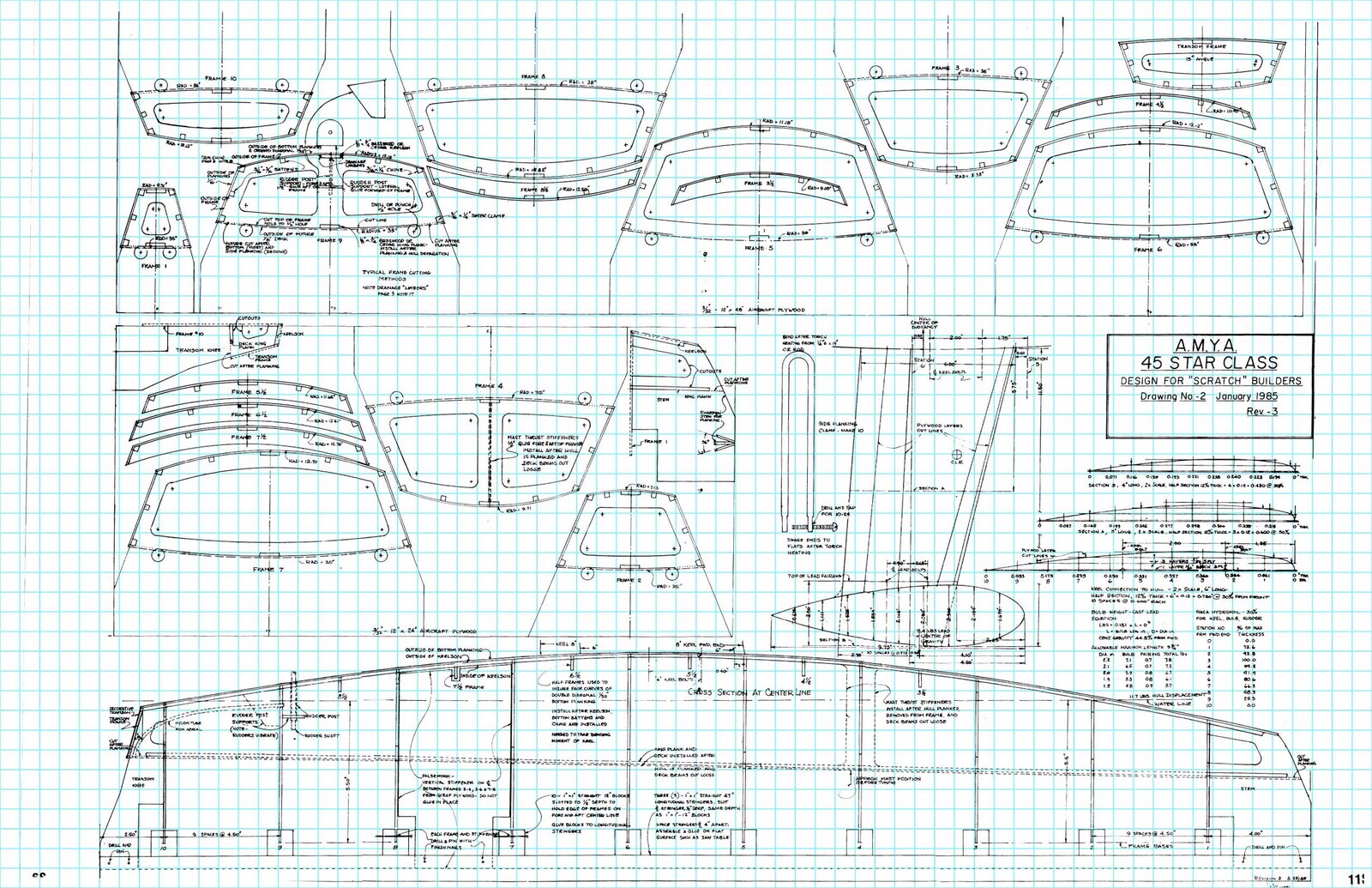


Do you find information about Small Boat Plans And Kits are you looking for? If not, below may help you find more information about the Small Boat Plans And Kits. Thank you for visiting, have a great day.
Read More..

Minggu, 13 Maret 2016

Wooden Boat Plans And Kits


I FOUND A PROFILE of a Pearson Vanguard in a boating book the other day and I couldn’t help but be struck by how beautiful she was. That man Philip Rhodes could design a mean sheerline. Combined with low freeboard, Vanguards still look gorgeous 50 years or so after they were built.

The bow, in particular, has a cocky sheer and a rounded profile that seems just right for a seagoing boat, while the stern rises just enough to complement the wonderful curve that sweeps from fore to aft as befits a creature intended to live among waves.

By today’s standards, the overhangs are excessive. The bow and the stern overhangs measure more than 10 feet combined on a boat only 32 feet 7 inches overall. But today’s boats have traded beauty for utility and interior space, which is a compromise not necessarily for the better.

Designers tell us that overhangs enable a boat to go faster. They increase the boat’s waterline length as she heels, and waterline length, as we all know, is the major factor affecting the maximum sustained speed of displacement boats. I have never been convinced of this alleged benefit. Not for any good mathematical reason but just because I can’t believe it makes enough difference in waterline length to matter. I’m even suspicious about the very claim that heeling adds to waterline length. Some boats roll buoyantly upward, out of the water, as they heel. I bet they don’t add much, if anything, to the wetted waterline. And besides, when you’re running downwind, and not heeling, there is no gain in waterline length at all.

In any case, I personally don’t think the Vanguard’s overhangs are excessive. Another famous and very handsome design of that period, the Camper & Nicholson 32, had overhangs totaling 9 feet. Furthermore, L. Francis Herreshoff, the great master, designed what he called “sensible cruising boats” with overhangs very much like the Vanguard’s. His famous H-28 ketch, at 28 feet overall, had a waterline of just over 23 feet.

There’s no doubt, though, that very long overhangs are dangerous at sea. They’re very elegant, but on smaller boats they’re suited only to sheltered waters. They cause pounding at the bow and slamming at the stern.

A friend of mine once took his 30-Square Meter to sea. This was a narrow-gutted formula racing class with very long overhangs, because the goal for naval architects was to design the fastest sailboat you could build with a maximum of 30 square meters of sail area. My friend got caught in quartering seas and found that the leverage afforded by the long stern overhang caused each overtaking swell to spin the boat almost broadside on, into a dangerous broach. Those 30 Squares were gorgeous to look at, and extremely satisfying to sail to weather, but they were lousy seaboats in bad weather.

The Vanguard was designed in the days when the Cruising Club of America (CCA) rule applied, of course. When that rule was superseded by the International Offshore Rule (IOR), the rear ends of racing boats suddenly changed from generous, flowing, callipygian sterns to mean and tight pinched-in haunches, often with unsightly reverse-sheer transoms. This did nothing for seaworthiness or looks. It just helped a boat get a better handicap under the IOR formula.

Manufacturers of cruising boats, like lemmings plunging over the cliff, followed the style of the racers, of course, in the hope that prospective clients would be impressed. So we had a very ugly production run of racer/cruisers in the 1970s and early ’80s. Happily, though, there were the occasional standouts, like Pearson and Philip Rhodes.

I feel thankful to them every time I see a Vanguard.

Today’s Thought
Perhaps the greatest difference between the beautiful yacht and the plain one is the way their crews treat them, for the crew of the beautiful yacht usually gives her tender loving care.
—L. Francis Herreshoff

Tailpiece
Overheard at the yacht club bar:
“My dirty bottom is really wreaking havoc with my performance.”
“Yeah, just imagine what that would do to your boat.”


Do you find information about Wooden Boat Plans And Kits are you looking for? If not, below may help you find more information about the Wooden Boat Plans And Kits. Thank you for visiting, have a great day.
Read More..

Selasa, 01 Maret 2016

Boat Building Plans And Kits


SOME YEARS AGO I helped construct a seaworthiness quiz for Small Craft Advisor magazine. The quiz was designed to give the owners of small sailboats a reasonable idea of how seaworthy various designs might be. And, perhaps more importantly, it demonstrated for them the desirable qualities that add up to seaworthiness in very small craft.

But now and then someone comes along and says: "What were you thinking? How can such small boats be seaworthy?" Well, they say that a little knowledge is a dangerous thing, and that’s what most of these someones are equipped with.

It’s quite obvious that dinghies and their ilk can’t meet all the qualities necessary to claim seaworthiness for larger vessels, ones that can accommodate people in the shelter of a cabin. But sailing dinghies can indeed provide two of the most important qualities: to stay afloat and to keep their crews alive.

If those someones had done their homework, they’d know that tiny open boats have made remarkable ocean voyages that demonstrate their seaworthiness. I could mention Captain Bligh, for a start, and Webb Chiles, who singlehandedly sailed his open, 17-foot, Drascombe Lugger, Chidiock Tichborne, almost all of the way around the world. And then there was Frank Dye, who sailed his 16-foot Wayfarer dinghy hundreds of miles across the North Sea from Scotland to Iceland, and to Norway.

These sailors provided an element of seaworthiness that their small craft lacked, of course. They were all expert seamen. In fact, when faced with storms at sea, Dye, in his unballasted, centerboard dinghy, would lower the mast, set a sea anchor so that the boat faced into the oncoming seas, and then lie down on the floorboards and go to sleep. “There’s nothing much else to do,” he said. Except pray, perhaps.

In coastal cruising, much of the seaworthiness of a dinghy like the Wayfarer lies in its ability to run for shelter close inshore, to maneuver closely among rocks, and to land on a beach and be pulled up out of harm on inflatable rollers. Larger, less nimble yachts with deep keels would not dare close a shore like that in heavy weather; their only recourse then is to seek deep water offshore, where their seaworthiness will be well tested.

In at least one way, the smaller the sailing dinghy, the more seaworthy it is. That is when the worst happens and the boat capsizes. The smaller the boat, the easier it is for the crew to right her.

The well-found camp-cruising dinghy cannot sink — she has built-in buoyancy. With a sealed mast and boom for flotation, she cannot turn completely turtle, and so the crew can stand on the centerboard to right her. She will also have self-bailers that will draw all the water from the cockpit once she comes upright again and gains way.

So there’s no doubt in my mind that small boats can be seaworthy. They can’t provide the shelter and comfort of a larger vessel, admittedly, but their closeness to the water provides delicate insights and thrills unknown to those lofty someones who batter their way through the seas in their seaborne chariots, carefully insulated from both the sea’s danger and its intimate delights.

Today’s Thought
There are many advantages in sea-voyaging, but security is not one of them.— Sadi (Emerson, English Traits: The Voyage)

Tailpiece
“That’s a funny-looking dog you’ve got there.”
“What? I’ll have you know I paid $1,000 for this dog. He’s part terrier and part bull.”
“Which part is bull?”
“The part about the $1,000.”

Do you find information about Boat Building Plans And Kits are you looking for? If not, below may help you find more information about the Boat Building Plans And Kits. Thank you for visiting, have a great day.
Read More..

Jumat, 26 Februari 2016

Boat Designs And Plans


BOATS I HAVE OWNED have taught me a lot in my lifetime. I guess I ought to be giving thanks to them right now. So, OK, thanks to:

My International sliding seat canoewhose name I have happily forgotten. She taught me how ancient Roman army catapults worked. Every time a gust came along I was catapulted off the sliding seat and over the boom into the drink.

Shane, a 14-foot Sprog one-design. My thanks to her for teaching me that having a fast boat doesn’t necessarily mean you’ll win races. It needs cunning and deviousness as well.

M’aidez, an 11-foot International Mirror Class dinghy, for alerting me to the fact that you should never name your boat M’aidez if you ever want to call anybody on VHF radio.

Mother’s Ruin, another Mirror, taught me how to wage  psychological warfare against racing competitors. Old Band-Aids stuck on a brand new mainsail seemed to distract them greatly as I sailed past.

Messy, another Mirror, taught me the valuable lesson that there are various forms of polyester resin, at least one of which will not cure if you don’t exclude air from its surface.  Her taped seams never got hard, never accepted paint, so I deliberately gave her a splodgy paint job and painted her name on her sides with a whitewash brush.

Trapper, a C&C 27, deserves my thanks for raising my social status at the yacht club.  Everybody admired her looks, if not my racing results.  A sweet boat.

Freelance, a Performance 31, by Lavranos, carried me and my family to a new life in America and taught me how to lie ahull in 50-knot winds off the Cape of Storms.

Square One, yet another Mirror, was a wreck I found in Los Angeles. She taught me how to restore a wooden boat in a garage in an apartment block without alerting the tenants directly above.  I learned their habits, and did my banging and sawing while they were showering or listening to loud TV. Nobody reported me to the fierce landlady.

Square One II. Yep, a Mirror again. Another wreck, this time in Seattle. I learned that I could

use an epoxy paste to replace a whole ply of marine plywood that fell off the starboard topsides. I was very proud of that repair job.

Tagati was a Santana 22 that showed us the glories of Puget Sound, the San Juan Islands and the Canadian Gulf Islands. Fast, simple and easily handled. I spent 13 months restoring her and should never have sold her.

Jabula, a Cape Dory 25D, took us around Vancouver Island on a six-week trip and allowed us to to meet an Oregonian cruising couple who gave us their recipe for gravlox salmon, which became our most-requested dish ever.

Sangoma, a Cape Dory 27,  took us around Vancouver Island again and taught me that you can  tow a heavy-displacement full-keel sailboat for two miles behind a small dinghy in a calm if you know how to scull with one oar over the transom. Yes, our engine broke down, but I got her into a small port from which a friendly Canadian boat towed us 10 miles to the area’s only mechanic.

Eclipse, a Cal 20, one of Gary Mull’s finest, taught me that I don’t like outboard engines that work in small wells let into the cockpit. She was a champion sailor, but I couldn’t stand the idea of her propeller protruding beneath the hull and causing drag all the time.

And finally, I have to mention Tokoloshe, a 10-foot, narrow-gutted, fiberglass fishing skiff that served as tender for the last four boats I owned. She was an unfinished mongrel of a boat, but without peer for seaworthiness. We towed her for thousands of miles, including hundreds in the open Pacific, and she never gave us a moment’s worry. Perhaps it was because I warned her that if she ever gave us trouble in a heavy following sea, I wouldn’t hesitate to cast her loose. I give thanks that It was a threat I never had to carry out.

Today’s Thought
So once in every year we throng
Upon a day apart,
To praise the Lord with feast and song
In thankfulness of heart.
— Arthur Guiterman, The First Thanksgiving

 Tailpiece
"Why did that sailor buy drinks for all those girls?"
"He likes to have a port in every sweetheart."


Do you find information about Boat Designs And Plans are you looking for? If not, below may help you find more information about the Boat Designs And Plans. Thank you for visiting, have a great day.
Read More..