Tampilkan postingan dengan label river. Tampilkan semua postingan

Senin, 21 Maret 2016

Boat Plans Butler


It takes teamwork to land these fish - Adam Tavender

I first was lucky enough to make it to the Dean River on the central coast of British Columbia for my first trip in 09. The Dean is the most revered river in the world among steelhead and salmon fly fisherman. If you are reading this, you likely already know that. So for me as a broke fishing guide, the opportunity to see this magical place and wade in the Deans sacred green waters for a week was a feeling that is impossible to describe. To say that I was riding a high on the float plane ride-in would be a gross understatement. As soon as I touched down on the bay and saw the place, I knew this would have to be an annual trip for me that I wouldnt want to ever skip.

Grantham falls is adjacent to the lodge while the Hickmans tug 
WyEast is moored in the bay out front
What makes the lower Dean River so special is tough to understand until youve been there. The place has a powerful energy. A large fjord called the Dean Channel delivers saltwater far inland to the heart of the impressive and dramatic BC Coast Range mountains. This places the mouth of the river directly in the middle of the large glaciated mountains. Views from the river include 8500ft peaks rising nearly vertical from sea level. Water falls cascading over a thousand feet, glaciers and untouched wilderness. While soaking up the views, your nose is filled with that refreshing coastal ocean air. Ive even had a pod of Orcas swim past me just off of the rivers mouth while standing alone knee deep in the rivers lowest run called Sub Tidal.

Fishing was tough by Dean standards that first week, but I had a blast and caught some of the nicest steelhead I had ever seen including battling the largest steelhead of my life for 30 minutes before defeat.


Release!
Anytime you can encounter a steelhead or Chinook is a special thing and these steelhead and Chinook are about as special as they come. These deeply wild fish have been locally adapted to navigate the fierce Dean canyon. Called the falls by many, it is essentially a half mile long Class 5+ rapid less than two miles from the slat water. Weak and smaller fish are unable to ascend the canyon. The fish in the lower river are supercharged to power through the canyon. They have robust shoulders, oversized paddle tails, mirrored sides and totally translucent fins. From June- September there are no fish more fresh from the salt or higher quality anywhere.

Kathryn battles Chrome!
My love for this place, along with the willing nature and trust of my wife Kathryn, led us to take out a big loan last year in the Spring of 2014 and make the biggest leap of faith of my life. We bought the small fly fishing lodge situated above the saltwater near the mouth of the Dean River. We bought the lodge from the Blackwell family and have since renamed the lodge Kimsquit Bay Lodge. We continue to put our personal touch on the operation and build upon the high standards of comfort and customer service that the Blackwell family created and maintained for 20 years.

Remote Seclusion! 
For Kathryn and I, the lodge was a way to join forces and work and live together year-round. Before the lodge Kathryn worked a full time job in Hood River and I bounced back and forth seasonally guiding long days on different rivers spread out across Oregon. We had two houses and only saw each other on the weekends during the Winter and Spring seasons. and hardly at all during the busy Fall Deschutes camp season. Now we can earn a living together. We spend our Summers running the lodge on the Dean and the rest of the year guiding steelhead in Oregon on the Deschutes, Clackamas and north coast rivers. We havent looked back since and this has been an amazing adventure and learning experience for us. We still feel incredibly lucky to live the lives we live and experience the things that the lodge and guiding lifestyle provides. We hope you can come visit us at Kimsquit Bay Lodge and experience it with us!

-Jeff Hickman
FISH THE SWING
(971) 275-2269
www.fishtheswing.com
www.kimsquitbay.com
Photos by Jeremy Koreski

Openings and rates for my Kimsquit Bay Lodge the 2015 season.

All weeks are $6150 (except July 3-10 is $6650) 7 nights 6 guided days, last day unguided, all meals and wine with dinner. 6 rods, 2 guides
  • June 19th - 26th 
  • June 26th - July 3rd
  • July 3rd - 10th - $6650 - 2 spots remain
  • August 7th - 14th - 2 spots remain
  • August 14th - 21st - 6 spots open 
Jerry Swanson
Fish Head Expeditions, LLC
jerry@fishheadexpeditions.com

503-539-1451

"Fly Fish the World with Us"


Do you find information about Boat Plans Butler are you looking for? If not, below may help you find more information about the Boat Plans Butler. Thank you for visiting, have a great day.
Read More..

Sabtu, 19 Maret 2016

Boat Blind Plans


Summer 2015 open dates

Sandy River Steelhead - Photo Courtesy of Trevor Covich

Aleutian Adventures – Sandy River Lodge

A small intimate lodge with legendary fishing. The fish are direct from the Bering Sea. The remaining space is for steelhead, with the King season sold out. The price is
$7600 and includes the charter from Anchorage.
  • Oct. 4-11, 1 space, 
  • Oct. 11-18, 1 space

Aleutian Adventures – Hoodoo River

Hoodoo River King

The is a 6 person very comfortable riverside camp, located right in the fishing. These fish are also direct from the Bering Sea. The price is $5100 and includes the charter from Anchorage.
  • Kings June 21-28, 1 space
  • Silvers August 15-22, 22-29 and Aug. 29-Sept. 5 - (each week has one space) 


Aleutian Peninsula, Alaska


Hoodoo River Silver
In September 2013 I was fortunate to fish with Aleutian Adventures on the Hoodoo River and a couple of coastal creeks. We fished for silver salmon aka Coho, using a variety of gear and techniques. The Hoodoo is a decent sized river that has easy wading with sandy or gravel bottom. The coastal creeks were smaller in scale and dumped directly into the Bering Sea. We fished where you could see and hear the ocean as well as explored upstream. The tidewater fishing on the lower reaches was very special. I fished a floating line with a 12’ leader, while others fished with a sink tip. The floater had the advantage of the fly not stalling out in soft water.


If you have fished for Coho, you know that the bite goes on and off. Sometimes changing your fly pattern, depth or speed will elicit more action. When the bite was on fishing the swing with a slow or sometimes fast retrieve were very effective. Fishing the shallow water that was 3’ or less we would have bow wakes coming at the fly, followed by a big grab. No nibbling!

The rods I used were Sage Switchers in 6 and 7 weight with Skagit short lines and sink tips ranging from T-14 to MOW medium 7 ½ foot sinking. Also used were Sage 10’ 8 wt with floating line and 9’ 7wt with floating line.

Jerry Swanson: Fish Head Expeditions
The season is mid June into July for Kings. The Coho fishing begins in August and goes into October.
The Steelhead fishing starts in mid September and goes into mid October or when the weather closes it out. They take 6 anglers per week. This is not a steelhead destination, but more of a bonus. Quite the bonus though.

Please email or call for more information. The program is evolving for next season with a charter flight from Anchorage in the works and some additions to the fishing program.


Jerry Swanson
Fish Head Expeditions, LLC
jerry@fishheadexpeditions.com

503-539-1451


"Fly Fish the World with Us"


Do you find information about Boat Blind Plans are you looking for? If not, below may help you find more information about the Boat Blind Plans. Thank you for visiting, have a great day.
Read More..

Kamis, 17 Maret 2016

Boat Plans Stitch And Glue


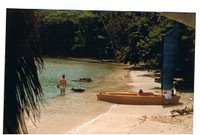
We arrived in Panama just in time that I could buy a few sheets of marine 1/4 plywood before the Panama Canal Company went out of business. No trailers or launch ramps available, shallow coral reefs off all the beaches, but beautiful deserted coves to visit with (by now) an entire family. So I designed a little yellow skiff, 4 (40" waterline beam) by 15 1/2 , with a daggerboard, rudder and sprit sail. I was able to get Sailrite sail cloth and WEST epoxy through the mail. Again, I calculated the length of the chine, sheer, and sheathing panels and all offsets so that the parts went together smoothly without having to use a strongback. The only drawings I used were just sketches for visualization. I had estimated the hull rocker correctly in design so the boat performed nicely. We went picnicing, snorkeling, fishing and just exploring. It was light enough that we could cartop the boat on our Toyota to bays along the Atlantic coast.

Do you find information about Boat Plans Stitch And Glue are you looking for? If not, below may help you find more information about the Boat Plans Stitch And Glue. Thank you for visiting, have a great day.
Read More..

Sabtu, 12 Maret 2016

Boat Trailer Plans Australia


Photo Credit Steve Turner

It never fails, at the end of the Klickitat steelhead season when it closes on November 30th that I’m always bummed that it comes too quickly. 

 For years I had attended meetings to try and get the “authorities” to keep it open until the end of Feb or March and beginning December 1st make it artificial, and barbless lure only to remove any hatchery fish that could possibly try to spawn with the wild steelhead. I had several reasons for trying to keep it open, the first was selfish and that was to prolong my fishing season on my favorite river and the second was that It made no sense to me, to close a river where there are hatchery fish in the system, when biologist will straight up tell you that they don’t want hatchery fish spawning with the wild fish.

Through studies that I have done with biologist in the past we discovered five different genetic strains of wild steelhead in the Klickitat River. If you’re trying to protect the spawning wild fish by closing it, then the artificial, barbless lure/fly makes perfect sense. We could continue to fish and harvest any hatchery fish meanwhile protecting the wild fish, who typically take artificial lures and flies less deeply than bait. Everyone including the steelhead wins. Ok, small rant to open the article, my purpose? To spark a thought in your head on why we do things sometimes the way we do them. I know the reasons, and it can be complicated at times, but that’s a whole other article we’ll save for another time. With my little rant over, the good news is that the season opener is right around the corner. Already!


2015 | Low Water – Different Approach

Spring Chinook will grab a fly slowly swung like molasses.  
Slow down grasshopper.
This past winter we have, to say the least, had no winter. Depending on where you look for information you will see that we are anywhere between 11 to 20 percent of our needed snow pack. This basically means we are in a drought year. If you look at the river levels of the Klickitat right now, you will see that we are about half the level (cfs: cubic feet per second) that we should be typically during this time of year. This translates in to low water conditions and even though the Klickitat is a glacial fed river, which typically means colder water temperatures than non-glacial fed streams, we could see warmer than usual temperatures as well. There will be less water for the fish to hide in so we will have to adjust the way we approach and fish it. At this point the Klickitat is getting strong numbers of steelhead already, before the opening date of June 1st.

I have had seasons where steelhead fishing has been really good during the opening week. At the time of me writing this, the word on the street is that the Klickitat will be open throughout the river for Spring Chinook as of June 1st, with a two adult limit (typically it wouldnt open until August 1st unless the hatchery upstream has gotten its quota) …and…and, the daily bag limit for steelhead has been set for 3 hatchery fish per day (typically it’s a 2 fish limit). Time will tell as the season progresses, just be ready to adjust as needed.

Temps | Tactics

Temps: Steelhead and Chinook are cold blooded and they are susceptible to both cold and warm water temperatures. Ask any veteran steelheader or biologist and they will confirm that water temperature will dictate how active fish will be, and where they will most likely hold, this isnt a big secret but it’s worth reviewing. To keep this portion short there are three temperature ranges that I want to touch on.

  • Mid 60’s to over 70 degrees: This is when steelhead will be mostly inactive. They will become lethargic, kind of like you or I getting out of the hot tub. Your energy is drained and you’re tired. Anything over 68 to 75 degrees (depending on each river) can be lethal to steelhead and Chinook. There are numerous studies on the internet about water temps and the effects on steelhead and Chinook, if you want to go deeper into the details simply Google it and knock yourself out. If I were to fish a river with temps in this range, I would be on the river at the crack of dawn when water temps are at the coolest and I would stop fishing once the river temps reach the lower end of this gauge. I would concentrate on the faster choppier heads and tailout’s of runs, forgetting the slow water. Fish that are landed in rivers where the temps are over 70 degrees do not fare well and their survival rate decreases due to the stress involved in battle. I encourage you to not fish when temps reach over 70 degrees for the fishes sake.
  • Mid 40’s to Low 60’s: This is ideal temperatures for active fish. I really like it when the temps are 45 to 55 degrees. You will find fish all over the place at these temps. Active steelhead will chase flies in every column of the river in this temp range. Skating a dry, swinging a wet, or dredging the depths it’s all good. This is where you will want to fish the entire run head to tailout. I recommend going through the run first with your skated or subsurface wet fly, then going back through with an intermediate sink tip and if you feel up to it, a third time with a sink tip. This will cover that run completely. You could honestly say that you gave that run a legit covering. I have done this, especially when I have the chance to fish a prime run. Ive hooked them just under the surface and then went through again and hooked them on a sink tip. If you are skating a fly on the Klickitat I would start out with a good sized one, the main reason is because Klickitat River like bigger skated flies than say the Deschutes, if you get a player to come up to the surface but you fail to hook him, immediately put on a smaller one, and if that doesnt do the trick, swing a subsurface wet fly through there, he’s a player so play with him. A couple falls ago I played cat and mouse with a steelhead for over 45 minutes, changing my fly 5 times before he’d had enough and didn’t want to play anymore. It was crazy fun and intense! I was engaged with the game and had a blast. One of my all-time favorite flies is the Purple Muddler Minnow on a floating line or a sink tip, doesnt matter, it puts steelhead on the beach. If skating in October I wouldnt overlook the October Caddis, we have monstrous October Caddis on the Klickitat, October Caddis as big as some butterflies, hence the bigger skater.
  • Low 30’s to Low 40’s: Here steelhead will begin again to become less active and the lower the temps get the more lethargic they become. Again they are kind of like you and I, when I’m cold, and the colder I become, the more my fingers don’t like to work and all I can think of is getting back into my comfort zone. To be successful at these colder temps you will definitely forget about fishing 75 percent of the places you normally could find a steelhead when temps are more ideal. This is the time to concentrate your efforts in the deeper slower pools. Steelhead will actually stack up in pools like cordwood to take advantage of the slow moving current and conserve energy. I have had ridiculous fishing (numbers) when I used to Centerpin and nymph fish when the temps were in this range and the fish were stacked up. This can be a difficult time to take a steelhead on the swing, not impossible but challenging. This is where slowing your swing way down to a crawl and letting it hang for an extended amount of time could pay off. I have landed steelhead on the swing with water temps at 31 degrees. I know that in some places steelhead have even been taken on skated flies in these temps but it’s usually in shallow clear water where they don’t have to move far to take the fly.
  • In short, when water temperatures are low, you’ll find the fish in the softer water along the edges of the river and in slower, deeper runs, pools and flats. They lie in these places to avoid fighting the current. On the other hand, the warmer the temps, the faster, choppier water you’re going to find them in, this is where oxygen will be sufficient and needed. The Klickitat has lots of long shallow choppy tailout’s from one to three feet deep which will be ideal places to swing or skate your fly in low, clear and warmer water temps.

Don’t go to the Klickitat in early season with wimpy hooks, 
these fish will destroy them and leave you with a souvenir!
Now, let’s talk about the Klickitat River while temps are fresh in our minds. Typically the Klickitat runs colder than most rivers around here due to the fact that it is a glacial fed river. Compared to the famous Deschutes River in Oregon which most of the time has ideal water temperatures for skating and swinging flies, the Klickitat is considerably different. The “D” temps are typically warmer and you have huge classic runs with major holding lies and active fish which is the very reason the river is world famous and precious to the steelhead junkie. The Klickitat although smaller in size has lots of classic runs and holding water, but it runs colder, so the fish react differently to the fly at times. This is not to say that it’s impossible to have awesome action on the swung fly but it can be more of a challenge to get them to take the fly, just ask anyone who has fished the Klickitat and the Deschutes in the summer and fall and they will agree with what I am saying. There is a reason that 90 percent of the guides guiding on the Klickitat River are nymph fishing most of the time. It’s because it’s easier to get a steelhead in a smaller, colder stream to bite while being spoon fed than it is for them to chase something down to attack.

When I fish the Deschutes in mid-summer and throughout the fall, I am very confident, dare I say, know that I am going to hook steelhead on the swung fly. It’s rare that I don’t. It’s happened, but not often. On the other hand, the Klickitat can test you. You might make multiple trips over there and spend hours before you get a grab. Ive had years where 80 percent of the time I went over to fish before going to work in the Gorge Fly Shop I would hook one to three steelhead on the swing, then Ive had times I might make 6 trips over without a grab. So, I say all that to say, that on a river like the Klickitat, you have to have a game plan. I probably sound like a broken record because I know that I have shared this information in past articles. By taking temperatures you can dissect and determine where and how to fish, it’s that simple. Each river is different in its own way and to truly become intimate with a river you have got to spend time on it and pay attention to what is going on around you.

Sam Sickles grasp what we call a legit Klickitat River TOAD!

2015 Opening Expectations

My thoughts, looking forward to the Klickitat opening is that in this low water/drought year we are already seeing abnormal water levels, although I have not been to the Klickitat to take a water temperature, I would bet that it would be slightly warmer at this point as well. If we continue to have no rain, in conjunction with little snow pack, without a doubt the river will continue to drop and with the heat of summer around the corner, we will see warmer temps than usual. With such a small amount of snow pack I believe that we will have for the most part low clearer water than we typically do. We just don’t have the snow pack to keep the river at its normal spring levels. Last year we had better conditions in the middle of summer and I know of temperatures as high as 65 degrees where measured.

On another note, with low, clearer water and warmer temps we will definitely see more of the slimy, snotty, string like moss (my scientific name for it because I don’t know the real name of it) that grows on the rocks. Anyone who fished last summer when that stuff was growing knows what I’m talking about. With the sun rays reaching down to the bed of the river it makes prime growing conditions. We could see some challenging conditions this season to say the least.

With this all in mind and with the current fish counts, although it is still pretty early, but we are at about three times the ten year average so far for fish over Bonneville Dam. What does this mean? Well with good numbers of summer steelhead a possibility and with conditions Ive described, we could see some great action when the temps are in our favor. I am personally going to be a skating fool on the Klickitat this summer and you can bet that I will be aware of what is going on around me while I am on the water. I will be taking temperatures throughout the day to maximize my success but also to protect the fish. I will adjust my approach in the way that I fish. I have always wanted to become a better fisherman with a skated fly and I believe that this season, given the conditions, could be the year to become more proficient at it. Ideal conditions where the water is lower and the temperatures force them to lay in long fairly shallow tailouts, I could see some serious skating action. If my excitement becomes reality, you will definitely hear about it.

Examples of Skaters in various sizes to cover various conditions on the Klickitat River…Can’t Wait!

 Ive tied up some skaters that are ready for battle. As mentioned at the beginning of this article, only time will tell what happens and the changes we’ll need to make, in the meantime go to the river with a game plan, I’ll see you out on the water…

Klickitat USGS Water Data

John Garretts Guide to Early Season Steelheading on the Klickitat
Klickitat River Mid Season with John Garrett
Klickitat River Late Season with John Garrett

Remember, if you can’t find it at the Gorge Fly Shop, you don’t need it!


Gorge Fly Shop
John Garrett | Product Specialist

541.386.6977


"Fly Fish the World with Us"


Do you find information about Boat Trailer Plans Australia are you looking for? If not, below may help you find more information about the Boat Trailer Plans Australia. Thank you for visiting, have a great day.
Read More..

Minggu, 06 Maret 2016

Boat Plans Wooden


As you may have heard, the shantyboat nears completion and we are readying it for the Secret History of American River People expedition on the Upper Mississippi starting in a few days.

This is a research journey to gather and present the lost stories of people living on or adjacent to the river. You can read all about it at the project website.

You can follow our progress on our voyage. You may want to hear about our triumphs and travails and the cool people we meet. If so, you can get automatic updates via email (or Twitter or Instagram and so on) right here: http://peoplesriverhistory.us/contact/

I also hope you will keep in touch with us and send us contacts of amazing people we want to talk to on the Upper Mississippi.

Thanks for all your support that has made this project possible.


Do you find information about Boat Plans Wooden are you looking for? If not, below may help you find more information about the Boat Plans Wooden. Thank you for visiting, have a great day.
Read More..

Rabu, 02 Maret 2016

Boat Plans Bolger


Trout Spey Reels

Does one need a special reel for a trout spey rod? Absolutely! We must always be in pursuit of the perfect match of rod, REEL and line!

So what makes a perfect reel for a two hand trout spey rod outfit? While line capacity, drag performance and weight account for most of the answer ultimately we still get to make our own decision based on pure personal preference. Its hard not to like all fly reels. Machined aluminum, anodized colors and precision movement, whats not to like! If youre tired of standard issue offerings you can always spring for one of the many custom options including colors and engravings offered by many fly reel manufactures including Abel, Nautilus, Tibor and Bauer.

Just like in my previous line article (Trout Spey Lines - No Perfect Answer!), Im not going to go into every little detail about fly reels but instead review the reels I have used, what I like and dont like about them.

Bauer CFX4 Spey

While CFX #5 and #6 spey reels are not new the Bauer CFX #4 size is new. Brand New! I bought the first two to ever ship from the Bauer factory. Summer 2014 over lunch with Jon Bauer on my travels through southern Oregon an idea came to me that I instantly shared with Jon. I told Jon that current spey and switch specific reels are too large for my trout spey rod needs and most of todays single hand fly reels are too light to properly balance my two hand rods. Not to mention they just dont have a soulful look. Now Im not a retro reel enthusiast but I do love the look of a solid back reel and the extra metal adds the weight needed to balance a two hand rod. Jon Bauer understood my needs and agreed to do a run of CFX #4 with solid backs like the #5 and #6 CFX spey reels. He has some inventory of them and because the spool is the same as the standard CFX all color options are available including the inner drum and drag knob colors. At this time of writing we are currently the only Bauer dealer with this CFX #4 spey option on our website.

Solid!
Bauer reels are smooth operators with undetectable start up inertia.
Its one of the few reels that still uses hardwood handles, something that I like and find lacking on most modern reels. On the CFX model you will find the drag knob located on the crank side of the reel. This is an age old argument as popular as which hand should you retrieve with. I like the drag on the crank side, why would I want to reach around the reel to adjust drag and have to think about which way to turn the knob to adjust. Having the drag knob on the crank side makes it easy to adjust when needed and the design of the knob lets you reach in with two fingers to make an adjustment so as to avoid getting your knuckles whacked by the crank.

Specs - Bauer CFX #4
  • Diameter 3.75"
  • Weight 6.6 oz (scaled 6.6 oz) 
  • Capacity 330gr Airflo Switch Streamer + 100yds/20# backing
  • RIO Scandi Short VersiTip 320gr #5 + Rio Powerflex 0.024 running line + 100yds/20# (lots of room to spare)

The CFX #4 should handle any 3 and 4 weight spey/switch rods and lines and maybe have enough capacity for some 5 weight rods depending on your line choices.

Note about spey reel specs
There are so many variables in two hand reel specs that you really should take in consideration when choosing a reel size. How much backing do you want/need? What length and diameter of running line do you intend to use? What line or head system will you choose; (I.E. Skagit, Scandi, integrated or other)? I start out with 100yds of 20# backing. I consider that to be more than enough for the trout angler. Running/shooting lines are a pretty big variable. Are you going to use mono or a standard level line? How long do you need? 100 running lines are pretty much overkill and you could easily gain some reel capacity by trimming off the backing end to 70 or 80 and still have more than enough. Skagit heads need more space than Scandi heads...So you can see the many variables with reels. I generally find reels in the 6/7/8 weight category to be sufficient for 3/4/5 weight trout speys.

Tibor Light Back Country CL Wide

Not a "new to the scene" reel the Tibor Light Series of reels have been around for quite awhile. Modern in design but yet I feel they possess a look missing in so many of todays new reels.
I originally purchased my Back Country reel for my Sage Bass Series Smallmouth Rod but I had to try it out on my Winston 4110 Microspey. It is a perfect marriage! Balance, capacity and the soulful look is hard to beat. Id like to get another in a different color and return the bass red to the rightful place on the Sage Bass II rod but until I need it for that purpose its found a home on my Winston.
The drag is silky smooth and has done an excellent job of protecting lite tippet. I like the adjuster on it too. Do note that I retrieve right hand and that puts the adjuster on the forward end of the reel. This would be reversed to the rearward end for left hand retrievers. Ive had various different 3 and 4 weight spey lines on it with no capacity issues. I have also run a mono shooting line on it and never once did it slip out of the frame.

Specs - Tibor Back Country CL
  • Diameter 3 5/8"
  • Weight 5.5 oz (scaled 6.5 oz) 
  • Capacity Rio #5-320gr Scandi Short VersiTip + Rio Powerflex 0.024 running line + 100yds/20#.

Sage Domain

Sage Domain - Full Caged Frame
I paired a Sage Domain reel to my Sage ONE 4116 with the idea that it would be lined with a mono running line and a scandi head. The full cage frame would keep the mono tamed and the weight would be a good balance. I did a risky gamble going with the 5/6 size but it worked out perfect! The stealth black look goes great with the Sage One. The drag has functioned flawlessly just like I have come to expect from all my Sage reels. If I had any complaints it would be that the spool is hard to remove but thats not really an issue considering I dont intend on having extra spools for it. The Domain is a nice mix of modern features such as large arbor and precision drag while including important two hand functionality such as full caged frame and enough weight for rod balancing. Capacity seems generous to the point that I was able to make the Size  #5 work for me with a mono running line and a scandi head but you would want to get the #8 if level running line and/or skagit head is in your plans.

Specs - Domain #5
  • Diameter 3.60"
  • Weight 6.2 oz (scaled 6.0 oz) 
  • Capacity Rio #5-320gr Scandi Short VersiTip + S/A 0.021" Mono Shooting line + 100yds/20# backing

Lamson Litespeed #3

If youre seeking lightweight its hard to beat a Lamson Litespeed. While lighter than I prefer I have used a #3 Litespeed to do a lot of different line testings and it just works and looks great. Reliable effective smooth drag and large arbor for fast retrieves has given the Litespeed an incredible reputation as a highly effective fishing tool. I really have no complaints about any of the Lamson reels I own. Lamson actually has many great choices for the two hand enthusiast including the Speedster HD, ARX and Guru HD which are all full frame caged reels.


Specs - Litespeed #3
  • Diameter 3.75"
  • Weight 4.63 oz (scale 4.5 oz) 
  • Capacity - Rio #5 Scandi Short VersiTip + Rio ConnectCore 0.026 running line + 100 yds/20# backing
Lamson Speedster HD

Lamson Speedster HD #3

Modern, great looking, reliable and high performance are the words I will use to describe the Speedster HD Series of reels. Sure I love the soulful look of solid backs and hardwood handles of the more traditional style reels but youve got to respect the modern advancement of technology that comes with the Lamson Speedster. Its like comparing a 60s muscle car with a modern day Corvette. Both deserve our respect and what you choose is your choice and no choice is wrong! You certainly cant go wrong with the Speedster. I only wish they made it in black, (Hello Lamson: Hint! Hint!). While on the lite side of two hand reels I found my Speedster HD #3 to be in the ballpark of balance with the Winston 4110 Microspey.

Specs - Speedster #3 HD
  • Diameter 4.0" 
  • Weight 5.3 oz (scale 5.4) 
  • Capacity - Rio 325gr Skagit Max Short + S/A Textured Shooting line 0.032" + 100yds/20# backing...NOTE: This combo really packed the speedster but most of the line overkill comes from the S/A 120 of shooting line. You could chop that back to 90 and still have more than enough running line and get back lost capacity

Full Cage vs. No Cage

Caged (Lamson Speedster HD) vs. No Cage (Lamson Speedster)
Why use a full cage reel? The best reason to utilize a full cage is to help tame mono running lines. Mono running lines can be a love / hate relationship, you either learn to love what they can do for you or you end up hating how they can treat you. The advantages you get with mono such as longer casts have to be weighed out with the disadvantages such as tangling and coiling. One way to help tame mono is incorporating the use of a full caged reel. The cage part of the frame acts like a line guide and therefore removes some of the freedom a mono line has to coil around things or sneak out between frame and spool. In some cases a full cage reel can have an added benefit being that they usually weigh more than cage free designs thereby helping balance your two hand rod. So even if you never intend to use a mono running line you still might find a caged reel to be a weight benefit. An "easy to see the difference" example of this is the Lamson Speedster which is made in both caged and cage free models. The Lamson Speedster #3 (cage free) weighs in at 4.7 oz while the Lamson Speedster HD (caged) weights in at 5.3 oz. Although 0.6 oz is not a huge difference it is a noticeable difference in where your rod will balance.

To further this conversation about rod balance Id like to point out a couple details of interest. First is,  I find reels that are too heavy to be more annoying than reels that are too light. When a reel is too heavy you are constantly forcing the tip of the rod down. Personally I find it easier to fish a rod that I have to pull the tip up. Second item is you can always add weight to a reel but you cant remove weight. Weight can be added to a reel simply by adding some tungsten sink tip or lead core line to the arbor of your spool. 200 grains of sink tip material is almost 0.50 oz. Keep in mind to feel the actual balance of a rod you will need to have a loaded reel attached with the line strung through the guides and the head part of the line outside the tip top just as if you are fishing to get an accurate idea of how the rod will balance on the stream. Balancing a rod is not an exact science. Too many variables exist that change the balance points such as where do you grip the handle or how much running line is out the tip as well as what type of line are you fishing with. You really are just trying to get in the ballpark with reel weight and as long as youre in it you will have a comfortable effective fishing tool. When an outfit balances well you wont even notice it but offset the balance and it will become quite clear on the stream. I have tried a couple popular 8 weight large arbor salt type reels on my trout spey rods and while the capacity is great the balance was way off particularly to the annoying side of heavy whereas reels that are on the "too light" side of balance seem to lean on the side of acceptable.

My guess is if you are getting into trout spey you are probably already a seasoned angler. You probably already have some reels in your collection that might work great or they might help you to determine what weight or capacity you need for your rod. Send me your pictures and tell me what you like. I really enjoy hearing about your experiences. Thanks for reading.

Lines I use on these reels - Trout Spey Lines - No Perfect Answer!

My two hand trout adventures - Trout Spey Chronicles


BassProGreg


Greg Darling 
Gorge Fly Shop Internet Sales Manager | Product Specialist


"Fly Fish the World with Us"


Do you find information about Boat Plans Bolger are you looking for? If not, below may help you find more information about the Boat Plans Bolger. Thank you for visiting, have a great day.
Read More..

Selasa, 01 Maret 2016

Boat Plans Aluminium


One of the smarter things Ive done on the shantyboat, was to add a coaming around the edge of the cabin. A new vocab word for me as I slowly get all nautical during the one plus year shantyboat build:

coam·ing  

/?k?miNG/
Noun
  1. A raised border around a ships hatch serving to support the hatch covers and to keep out water.
  2. A similar structure around the cockpit of a boat.
The Glen-L Waterlodge plans didnt call for a coaming, since Glens cabin design was significantly different, and he wasnt nutty enough to consider board and batten as a cabin exterior material.

Take a look again at my wall cutaway diagram:


The coaming is the board labeled "edgeboard" against the inside edge of the side framing member.  My goal was to make sure that if water splashed up on the exterior board and batten, that it would not easily get into the boat, more so because I plan to fiberglass right up to and over the coaming.

Heres what it looked like without the coaming.


I had the lumberyard rip a few 2x6s edgewise to create the coaming. 


Of course, I epoxied and screwed it into place.


Later when we fiberglass the decks, we will create a curved filet at the inside corner and curve the fiberglass up over the coaming.

For some reason it strikes me as unusually handsome and boaty.


Do you find information about Boat Plans Aluminium are you looking for? If not, below may help you find more information about the Boat Plans Aluminium. Thank you for visiting, have a great day.
Read More..

Senin, 29 Februari 2016

Boden Boat Plans Australia


May 25, 2015

This week marks another significant change in the fishing opportunities this week as many of our local streams open up for trout fishing.  The following is a basic briefing of the fishing synopsis for our local streams

East Fork of the Hood River:  Open for catch and release trout from May 23 to October 31.  NOT OPEN FOR STEELHEAD OR SALMON

West Fork of the Hood River:  Closed to all angling above Punchbowl Falls.

Hood River (Main Branch): Open for catch and release trout until October 31.  It is also open for two fin-clipped steelhead year round.  All trout over 20” are considered steelhead.  Open for two fin-clipped adult Chinook salmon and five fin-clipped jack Chinook salmon until June 30. 

Eagle Creek near Bonneville Dam:  Open for catch and release trout from May 23 until October 31.  It’s also open for fin-clipped steelhead and salmon until August 15. 

Deschutes RiverThere is no salmon season this spring.  Two trout 10-13” may be retained.  Two fin-clipped steelhead may be retained, but there is no bait allowed except for the three miles below Sherar’s Falls. 

Klickitat River:  Currently open below Lyle Falls (mile 1.4) on Monday, Wednesday, Saturday and Sunday.  The entire river opens on Monday, June 1.  From the best that we can interpret the rules; retention of fin-clipped steelhead will be mandatory as of July 1.  You will be required to kill hatchery steelhead and you must stop angling once you have reached your limit.  There will be more on this later, I am sure. 
There has been an “emergency” rule change to increase the limit to three fin-clipped steelhead and up to two hatchery (fin-clipped) Chinook, but no more than three fish may be retained.  Only two of those fish may be hatchery Chinook. 

White Salmon River:  From the old, dilapidated bridge below the old powerhouse upstream to Northwestern Lake bridge:  From May 23 to June 30, two hatchery (fin-clipped) fish may be retained, either salmon or steelhead.  From July 1-31, the limit increases to three.  It appears that retention of hatchery steelhead will be mandatory here too. 
Trout fishing is open on the White Salmon from the first Saturday in June (June 6) upstream of the dilapidated bridge near the powerhouse until October 31.  Trout fishing from the mouth up to the powerhouse bridge is closed until August 1. 

This does not solve the problem of lack of accessible water on the White Salmon.  It is a steady class IV-V whitewater with steep canyon walls and is not recommended to go down there without serious whitewater gear (do not take a framed boat down there, paddle rafts only!)  There are serious waterfalls on every section and no actual boat ramps.  The traditional bait hole at the mouth of the river is still very shallow and filled in with silt, but is starting to carve out a little bit.  It’s a beautiful river with no access and dangerous water, no hatchery or wild fish, just the occasional stray.  It will take twenty years for the stray steelhead and salmon to establish a decent population after the dam (with no fish passage) was removed a few years back. 

Rainbow Trout on the Deschutes Riveris still the number one destination for local anglers right now.  Although the stonefly hatch has reached its peak, fishing should remain really good for the next few weeks, but anglers must have a variety of flies in the arsenal.  Make sure that you have nymph and dry versions of PMDs/PEDs, yellow sallies, and caddis (mostly in drab/dark colors).  Be prepared, fish can turn on to any “micro hatch” that happens during the day with fish moving from one pattern to the next relatively quickly.  An angler must be prepared to change flies often.  Even if a pattern was working an hour and two riffles ago, there is no guarantee that fish will still be eating it later in the day. 

Remember that there is NO FISHING FROM A BOAT ON THE DESCHUTES and also, fishing on the Warm Springs Reservation is highly regulated, so check the regulations before you start fishing on the wrong side… Some sections require a permit and others are prohibited all together. 

Spring Chinook are still looking good, although catch rates have dropped a little bit lately.  Pressure has slowed quite a bit too.  There have been few, if any anglers (besides Ian) down at the mouth of the Hood River lately.  Salmon can be found in any of our local rivers right now, but check to make sure that they are open to angling before you go. 

The Clackamas Riverhas been kicking out some summer steelhead as of late and pressure (and the flow) is pretty darn low.  Rivers that are closer to the ocean tend to get earlier returning fish than upstream tributaries like our local Columbia Gorge streams.  That being said, there are fresh steelhead in our rivers every month of the year, but chasing steelhead is a numbers game and you should go where the numbers are higher if you want success. 

Smallmouth Bass are an underrated fish around here.  They are big and plentiful and no one really ever fishes for them.  Look for rocky, shallow areas where wind and currents push against the rocks.  You will be mostly unsuccessful if you are fishing in wind-protected areas.  Unfortunately, smallies like to hang out in some of the windiest areas around.  There are tons of places on the Columbia Riverthat a guy could catch a mess o’ bass, but the key is finding some place that is getting pounded by the wind.    

The John Day Riveris another great place to catch smallies.  The access is easy and the fish are plentiful.  They are not as big as their kin in the Columbia River, but they are tons of fun nonetheless.  Thunderstorms blew the river out last week, but it should clear up by mid-week. 

Lakes have been fishing really well.  Goose Lakeis one of my favorite lakes to wet a line.  The fish are plentiful there and there are occasionally some bigguns.  Lost Lake has been fishing well too.  I really like Timothy Lake, Trillium Lakeand Clear Lakeup near Mt. Hood. Clear Lakeis a little quieter than Timothy, but they can both produce some really nice fish.  Trillium is stocked with “jumbo” trout and has some real hogs in it, but it is a small lake that is popular with hikers, swimmers and day-drinkers, so solitude is rare during on a hot day. 

Laurence Lake is a nice option for stillwater anglers too.  It has bait restrictions and is mostly a catch and release fishery.  Occasionally, anglers catch bull trout, but its mostly stocked rainbow trout that are fin-clipped.  Anglers must release all bull trout and all unclipped rainbow or cutthroat trout. 

I would be fishing damselfly nymphs in most of the lakes during this time of year, but Callibaetis hatches can be thick, and I don’t know too many trout that will refuse to eat a well-presented leech pattern. 


As always, we are happy to talk fishing any time.  Give us a call if you have any specific questions on local rivers, gear, and tactics, or if you just want some encouragement to get out of the office.


Fishing Reports Archived

2015 Klickitat River Season Opens | Already!?


"Fly Fish the World with Us"


Do you find information about Boden Boat Plans Australia are you looking for? If not, below may help you find more information about the Boden Boat Plans Australia. Thank you for visiting, have a great day.
Read More..

Boat Plans Canada


If theres one thing Im good at, its not being good as things.  But given my delightfully blinding optimism, I plunge on ahead anyway, learning a ton with each monumental goof.


You remember the cabin framing looked like this. Thats more or less an eight foot wall, with maybe 1 foot 8 inches below the deck of the hull.  The height was chosen more or less arbitrarily, based I think on having 8 foot two-by stock to work with for the framing.


At this point Im thinking all the great and rare 1x12 redwood we pulled from the decommissioned chicken coop was not going to be enough wood, and was gong to be too brittle, too bug eaten or rotten, and too heavy.  So I was pricing new redwood, though this was not my ideal.

When I got down to thinking about (and pricing) the redwood siding, I realized Id made a small but critical blunder. About 2-1/2 inches of blunder.

Had I made the walls a tiny tiny bit shorter, I could have used 6 foot long boards for the siding. This made a huge difference in the pricing since 1x12 or 1x10 redwood is already expensive, but longer lengths are even more so. With 6 foot lengths, I could easily cut 12 lumber in half, but the next common step up is 16 lengths, which were much more spendy and wasteful.


Well, the cabin already looked ridiculously tall, and I wasnt yet committed to the height, so I decided to do something crazy...


I cut the walls down 2-1/2 inches. I clamped my carpenters square to each stud to serve as a guide for my skillsaw and cut a few inches off of each stud.


Considering that everything was glued and screwed (or nailed), it wasnt easy. I had to remove the little stud nubs and glue and nail the top plate to the new tops of the studs.


It only took most of a morning to fix the height of the cabin.  Now the walls measure exactly six foot from the deck to the top of the walls.


As a consolation for my troubles (and perhaps reward for conscientiously correcting my mistake), I had a beautiful visitor that day.

Do you find information about Boat Plans Canada are you looking for? If not, below may help you find more information about the Boat Plans Canada. Thank you for visiting, have a great day.
Read More..