Tampilkan postingan dengan label on. Tampilkan semua postingan

Selasa, 22 Maret 2016

Boat Plans Bateau


THE ESTEEMED early-20th-century boat designer William Atkin once designed for himself a 29-foot wooden sloop that was remarkable in my eyes for one particular thing — she had no companionway steps.

“If you drop down into the cabin of Ben Bow (and you will have to drop down because there is no companion ladder) you will find the bunks aft, then the galley, then two pipe berths, with a water closet near the foot of the mast,” Atkin wrote in his book Of Yachts and Men.

“As I have just mentioned, in Ben Bow we do not have a companion ladder. Sort of a man’s boat she is. We are not yet so old or stiff as to be unequal to scrambling in or out her cabin.

“Just two steps does it, one being a projection shod with a bit of brass on the bulkhead, the second being a corner of the starboard locker top. And so we are rid of a ladder, a piece of furniture which is always, I feel, too much in the way.

“The ladies? Well, God bless ’em, we might lower them away on the end of a rope. Somehow women generally do not love boats. Think they are a little jealous of them, just a little. Or perhaps their natures are too much alike . . . uncertain sort’a, and feminine, and — well I suppose I shall have to admit it — lovely.

“The cabin has among other features, one wide berth on the port side set high from the floor and with large lockers underneath. Even our old friend Abel Brown, who tells racy tales about berths, cannot quarrel much with the dimensions of this one; ‘big enough for perfect comfort under any situation,’ he might have remarked.”

It was surely a strange aberration that made Atkin omit a companionway ladder on his own boat. It wasn’t something he normally did on the hundreds of other boats he designed. It’s true that the darned ladder does take up precious space on a small boat, but if you’re a man who wants to share the pleasure of sailing with a wife or lady friend it is surely an act of gallantry to provide decent access from the cabin to the cockpit. Sort of like flinging your cloak into a puddle, so Her Majesty can keep her dainty slippers dry. Only more permanent. And a definite investment in marital bliss.

Today’s Thought
The hardest step is that over the threshold.
— James Howell,  Proverbs. No. 7

Tailpiece
Groucho Marx once opened a drawer by mistake in a friend’s home. He found a Colt automatic pistol surrounded by several small pearl-handled revolvers.
“My God,” he said, “This gat has had gittens.”


Do you find information about Boat Plans Bateau are you looking for? If not, below may help you find more information about the Boat Plans Bateau. Thank you for visiting, have a great day.
Read More..

Boat Plans Building


IT’S HARD TO EXPLAIN to a landlubber what offshore sailing is all about. But William G. Homewood found a way to do it, after he had raced from Newport, Rhode Island, to Bermuda and back in a Ranger 26.

This is his description, as recorded in Richard Henderson’s book, Choice Yacht Designs:

“First, at home, you should go into the bedroom fully dressed and pour a bucket of water over your head. Put on your foul-weather gear and harness.  Prop up one side of the bed to an angle of 20 degrees, then pour a bucket of water over the pillow and bedding.

“Engage the services of a fork-lift (and operator) who will lift one corner of your house up into the air six feet and then let it drop down with a bang.  He should do this all night long, intermittently, without warning. Now, go to bed.

“After one hour of sleep it will be time to get out of bed, open the sliding door to the balcony, and peer out (checking the sails). At this moment a friend, well hidden, should throw a bucket of water onto the back of your head. Your jacket hood must be in the off position, as this will allow the water to run down your neck. . . .  As  you turn to go back into the bedroom, another well-hidden friend should club you over the head with a two-by-four. This simulates head blows from the  bulkheads. . . .”

There’s more that a landlubber needs to know, of course. You should fill your rubber boots with water and you should remember to throw up only on the lee side of the cockpit. You should preferably practice walking with one leg shorter than the other so as to remain upright on the slanted deck and you should develop arms like a gorilla’s so you can hang on to the handholds when a wave tries to wash you overboard.

You should also practice holding your bladder for at least eight hours because it’s impossible to get a hand on the outlet from your urinary tract when you’ve got a whole bunch of layers of clothing and waterproof pants on.

As for cheerful, sustaining hot meals — um, well, sorry feller. Ain’t gonna happen.

Today’s Thought
We have all sinned and come short of the glory of making ourselves as comfortable as we easily might have done.
— Samuel Butler the Younger, The Way of All Flesh

Tailpiece
Adolescence is a period of rapid change. Between the ages of 12 and 17, for instance, a parent can age as much as 20 years.

(Drop by every Monday, Wednesday, Friday for a new Mainly about Boats column.)


Do you find information about Boat Plans Building are you looking for? If not, below may help you find more information about the Boat Plans Building. Thank you for visiting, have a great day.
Read More..

Boat Plans Arch Davis


SOME YEARS AGO, about this time, I was pulling up the anchor on my boat when I injured my back. I herniated a disc. It was my own fault, I guess. What actually happened was that the shackle that joins the chain to the rope got stuck in the bow roller. I was in a hurry to get the anchor up, because we were too close to another boat, so I impatiently gave an extra-hard jerk on the line, instead of leaning over to ease it through by hand. The shackle popped through and at the same time a vertebra in my lower back went pop, too. It pressed against a nerve, and my right foot went numb.

I’m happy to say that my little injury has now mostly cured itself, as most injuries to the body do, given time. At least, it doesn’t hurt so much. But I still give much thought to the universal problem of raising the anchor, especially when you’re singlehanded.

You can use a winch to extract the anchor from the seabed, but as soon as it comes free, your boat will start to drift, most likely sideways into the anchored boat alongside you. The winch is just too slow for the distance the anchor must travel from the seabed to the bow roller. You need to be at the tiller and mainsheet or engine controls immediately the anchor comes unstuck. So you have no option but to haul it up by hand as fast as you can.

But the answer is simple. It was suggested in a conversation I had the other day with the owner of a MacGregor 26. It is the lightweight anchor. The very lightweight anchor. Not one of those ordinary lightweight aluminum things.

I have refined the concept and invented the Vigoranka Collapsible Anchor©. It weighs almost nothing. It saves space. You can fold it up or crush it into a tiny space without harming it. It is going to revolutionize anchoring as we know it.

The Vigoranka© works on the principle that water is very heavy in air but light in  water. So all you have to do is lower the sturdy plastic Vigoranka© into the water and let it fill. It will hold 75 pounds of water. Now when you consider that a 35-pound CQR will hold a 32-foot sailboat in almost any conditions, you can surely see the advantage of using an anchor that weighs more than twice as much.

But you can easily raise it to the surface by hand, and as it comes out of the water you simply flip a little valve and all the water drains back out into the sea, allowing you to bring the Vigoranka© aboard with one hand and no strain whatsoever.

Frankly, I am amazed that no-one has thought of this before. But then, no-one thought of Twitter before Twitter was invented, and now the world is just full of tweets everywhere. Which just goes to show you. 

Today’s Thought
The wonder is always new that any sane man can be a sailor.
—Emerson, English Traits

Tailpiece
“How’s the bird breeding going?”
“Great. I just crossed a homing pigeon with a parrot.”
“What for?”
“If the pigeon gets lost it can ask the way home.”

Do you find information about Boat Plans Arch Davis are you looking for? If not, below may help you find more information about the Boat Plans Arch Davis. Thank you for visiting, have a great day.
Read More..

Senin, 21 Maret 2016

Boat Plans Butler


It takes teamwork to land these fish - Adam Tavender

I first was lucky enough to make it to the Dean River on the central coast of British Columbia for my first trip in 09. The Dean is the most revered river in the world among steelhead and salmon fly fisherman. If you are reading this, you likely already know that. So for me as a broke fishing guide, the opportunity to see this magical place and wade in the Deans sacred green waters for a week was a feeling that is impossible to describe. To say that I was riding a high on the float plane ride-in would be a gross understatement. As soon as I touched down on the bay and saw the place, I knew this would have to be an annual trip for me that I wouldnt want to ever skip.

Grantham falls is adjacent to the lodge while the Hickmans tug 
WyEast is moored in the bay out front
What makes the lower Dean River so special is tough to understand until youve been there. The place has a powerful energy. A large fjord called the Dean Channel delivers saltwater far inland to the heart of the impressive and dramatic BC Coast Range mountains. This places the mouth of the river directly in the middle of the large glaciated mountains. Views from the river include 8500ft peaks rising nearly vertical from sea level. Water falls cascading over a thousand feet, glaciers and untouched wilderness. While soaking up the views, your nose is filled with that refreshing coastal ocean air. Ive even had a pod of Orcas swim past me just off of the rivers mouth while standing alone knee deep in the rivers lowest run called Sub Tidal.

Fishing was tough by Dean standards that first week, but I had a blast and caught some of the nicest steelhead I had ever seen including battling the largest steelhead of my life for 30 minutes before defeat.


Release!
Anytime you can encounter a steelhead or Chinook is a special thing and these steelhead and Chinook are about as special as they come. These deeply wild fish have been locally adapted to navigate the fierce Dean canyon. Called the falls by many, it is essentially a half mile long Class 5+ rapid less than two miles from the slat water. Weak and smaller fish are unable to ascend the canyon. The fish in the lower river are supercharged to power through the canyon. They have robust shoulders, oversized paddle tails, mirrored sides and totally translucent fins. From June- September there are no fish more fresh from the salt or higher quality anywhere.

Kathryn battles Chrome!
My love for this place, along with the willing nature and trust of my wife Kathryn, led us to take out a big loan last year in the Spring of 2014 and make the biggest leap of faith of my life. We bought the small fly fishing lodge situated above the saltwater near the mouth of the Dean River. We bought the lodge from the Blackwell family and have since renamed the lodge Kimsquit Bay Lodge. We continue to put our personal touch on the operation and build upon the high standards of comfort and customer service that the Blackwell family created and maintained for 20 years.

Remote Seclusion! 
For Kathryn and I, the lodge was a way to join forces and work and live together year-round. Before the lodge Kathryn worked a full time job in Hood River and I bounced back and forth seasonally guiding long days on different rivers spread out across Oregon. We had two houses and only saw each other on the weekends during the Winter and Spring seasons. and hardly at all during the busy Fall Deschutes camp season. Now we can earn a living together. We spend our Summers running the lodge on the Dean and the rest of the year guiding steelhead in Oregon on the Deschutes, Clackamas and north coast rivers. We havent looked back since and this has been an amazing adventure and learning experience for us. We still feel incredibly lucky to live the lives we live and experience the things that the lodge and guiding lifestyle provides. We hope you can come visit us at Kimsquit Bay Lodge and experience it with us!

-Jeff Hickman
FISH THE SWING
(971) 275-2269
www.fishtheswing.com
www.kimsquitbay.com
Photos by Jeremy Koreski

Openings and rates for my Kimsquit Bay Lodge the 2015 season.

All weeks are $6150 (except July 3-10 is $6650) 7 nights 6 guided days, last day unguided, all meals and wine with dinner. 6 rods, 2 guides
  • June 19th - 26th 
  • June 26th - July 3rd
  • July 3rd - 10th - $6650 - 2 spots remain
  • August 7th - 14th - 2 spots remain
  • August 14th - 21st - 6 spots open 
Jerry Swanson
Fish Head Expeditions, LLC
jerry@fishheadexpeditions.com

503-539-1451

"Fly Fish the World with Us"


Do you find information about Boat Plans Butler are you looking for? If not, below may help you find more information about the Boat Plans Butler. Thank you for visiting, have a great day.
Read More..

Sabtu, 19 Maret 2016

Boat Plans Bolger


THE PLANETS are in line. Sports Illustrated’s swimsuit issue has a size-16 woman on the cover for the first time. Playboy magazine has stopped publishing nudes. Something’s going on. Should we duck or run for cover?

Of the three, Playboy seems the most ominous. It’s the Internet, of course. Men no longer have to buy Playboy to find out what women actually look like under all those clothes they wear.  The Internet is full of free photographs of naked women, the great majority of them taken and submitted by themselves.

In the old days when I worked in South Africa, you weren’t allowed to see women’s bodies until you got married. Any book, film, or magazine with a naked woman in it was banned. The apartheid censors were rather cavalier in this respect. They even banned books without first reading them. For example, they took one look at the title of Anna Sewell’s best-seller, Black Beauty, and banned it immediately. It was actually about a horse, not a woman, and the censorship board suffered withering scorn when the news came out, but that didn’t stop them in their attempts to curb free speech.

Playboy was also on the banned list, of course, probably at the top of it. So when I found myself in Rio de Janeiro at the end of a transatlantic yacht race, I bought a copy of Playboy at a corner newsstand. I knew a man at the newspaper where I worked in South Africa who swore to uphold the traditions of free speech by hoarding a secret stash of Playboy magazines, which he rented out to trusted colleagues. He would pay me at least 20 bucks for it if I could smuggle it home. But I had a better idea.

I took it back to the boat, which the skipper was due to sail back home to South Africa with a new crew. I told nobody about it. I unzipped the cover of the starboard berth in the saloon, slipped the magazine into the bottom, and zipped it up again.

Weeks later, when the yacht arrived in Durban, I met the owner/skipper on board. In front of him, I unzipped the berth cover and there was my Playboy, untouched by human hand, pristine after thousands of miles of ocean travel. The skipper nearly fainted. “If Customs had found that they would have confiscated my boat,” he yelled. “Get it out of here.”

He obviously didn’t care much for free speech, so I took my Playboy to work, (after checking out the articles, of course) where I collected my money, and it joined the secret stash. Just another small blow for press freedom.

Today’s Thought
Free speech is not to be regulated  like diseased cattle and impure butter. The audience . . . that hissed yesterday may applaud today, even for the same performance.
— William O. Douglas, Associate Justice, US Supreme Court, 24 Jun 57

Tailpiece
“Is this the sound-effects department?”
“Yes.”
“Good, send me a galloping horse immediately.”
“What for?”
“Well, the script calls for the sound of two coconut shells being clapped together.”

(Drop by every Monday, Wednesday, Friday for a new Mainly about Boats column.)


Do you find information about Boat Plans Bolger are you looking for? If not, below may help you find more information about the Boat Plans Bolger. Thank you for visiting, have a great day.
Read More..

Boat Blind Plans


THOSE OF YOU who have experienced civilized upbringings must sometimes wonder why we always pass the decanter of port to the left after dinner in the main saloon. Well, the fact is that we don’t always pass it to the left, or clockwise.
We only pass it to the left in the northern hemisphere. In the southern hemisphere the decanter goes counter-clockwise. If you are ever in any doubt about which way it should go, just flush some water down the galley sink and see which way it revolves as it gurgles out. In the northern hemisphere it will revolve clockwise. In the southern hemisphere it will gurgle counter-clockwise. And those of you who paid attention in science class at school will know that this is due to the Coriolis effect, so named after the Italian plumber who first noticed it.

Port and cheese is a wonderful way to end a dinner on a boat and it needn’t always be a formal affair. For years we have recommended a small glass of port at sunset when at anchor for the night. Port travels better on boats than most wines do. In fact, I half remember reading somewhere that the Portuguese wine merchants used to ship cargoes of port wine as ballast aboard the Grand Banks fishing fleet so that it was suitably matured by the time they got back home to Portugal.

Cheese and crackers go well with port, and red grapes are good also, but if you’re adventurous you might want to try small bamboo skewers loaded with prosciutto, melon, and cheese. I should warn you that port and potato chips don’t make it.

Now, suppose you’re seated around the cabin table after a fine dinner in the northern hemisphere, and the person on your right neglects to pass the port to you, either by deliberate neglect because he doesn’t like you, or through sheer forgetfulness. What do you do? You would commit a gross breach of etiquette if you said: “Please pass the port.”

By tradition, you must say: “Do you know the Bishop of Norwich?”

Anyone with the civilized kind of upbringing I mentioned earlier will immediately pass the port, along with a suitable apology.  But if your question is met with a blank stare or an answer in the negative, you should say: “He’s a fine fellow, but he always forgets to pass the port.”

This is what is known in civilized circles as a heavy hint. If the guilty party does not respond by passing the port immediately, you are entitled to throw your gauntlet on the table and challenge him to pistols at dawn. Unless you are seated next to a lady, of course. If she looks nonplussed and fails to pass the port, I think you are entitled to grab it from her and help yourself without penalty.

Incidentally, although you may have a glass of port in front of you, obtained in the ordinary, non-combative manner, you should not take a sip until everybody has been served; and it is exceptionally bad form to drink your port before the main toast.

Incidentally, the decanter should be kept circulating until it is empty. This is because even the best ports start to deteriorate within 24 hours if they are exposed to too much oxygen. Most port benefits from an airing for a few hours before being served, to let it “breathe,” and pouring it from bottle to decanter, if done slowly and carefully, will get rid of most of the sediment that tends to collect at the bottom of the bottle. But there’s no point in keeping the remains for tomorrow. Even the ship’s dog wouldn’t look at it then.

Today’s Thought
Wine nourishes, refreshes, and cheers. Wine is the foremost of medicines  . . . whenever wine is lacking, medicines become necessary.
— The Talmud

Tailpiece
“Gimme a return ticket.”
“Yes, sir. Where to?”
“Back here, you idiot.”

(Drop by every Monday, Wednesday, Friday for a new Mainly about Boats column.)


Do you find information about Boat Blind Plans are you looking for? If not, below may help you find more information about the Boat Blind Plans. Thank you for visiting, have a great day.
Read More..

Jumat, 18 Maret 2016

Boat Plans Canada


If my wife were sitting in the forward seat, the boat waterline would be about exactly where I painted it.


Do you find information about Boat Plans Canada are you looking for? If not, below may help you find more information about the Boat Plans Canada. Thank you for visiting, have a great day.
Read More..

Kamis, 17 Maret 2016

Boat Plans Stitch And Glue


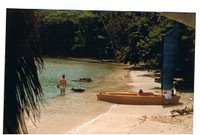
We arrived in Panama just in time that I could buy a few sheets of marine 1/4 plywood before the Panama Canal Company went out of business. No trailers or launch ramps available, shallow coral reefs off all the beaches, but beautiful deserted coves to visit with (by now) an entire family. So I designed a little yellow skiff, 4 (40" waterline beam) by 15 1/2 , with a daggerboard, rudder and sprit sail. I was able to get Sailrite sail cloth and WEST epoxy through the mail. Again, I calculated the length of the chine, sheer, and sheathing panels and all offsets so that the parts went together smoothly without having to use a strongback. The only drawings I used were just sketches for visualization. I had estimated the hull rocker correctly in design so the boat performed nicely. We went picnicing, snorkeling, fishing and just exploring. It was light enough that we could cartop the boat on our Toyota to bays along the Atlantic coast.

Do you find information about Boat Plans Stitch And Glue are you looking for? If not, below may help you find more information about the Boat Plans Stitch And Glue. Thank you for visiting, have a great day.
Read More..

Rabu, 16 Maret 2016

Boat Plans Aluminum


(Fourth in an occasional series)

As I have pointed out on several previous occasions in this blog, there seems to be an unreasoning prejudice in this country against outdoor advertising. Whatever one may think of the overall control of advertisements regime, one aspect that particularly irritates me is the extreme reluctance of some local planning authorities (in fact, I suspect, a majority) to countenance large banner adverts on shrouded buildings while they are in course of demolition, reconstruction or repair.

I have in the past acted for one or two of the companies engaged in this type of advertising, but I am not currently retained by these clients and so I have no professional or commercial axe to grind. I simply think that this type of advertising can be beneficial, both as a means of hiding an eyesore while the building work is in progress and in helping to finance the restoration of the fabric, not to mention brightening up the townscape for a time.

Other countries do not seem to have the same hang-up with this type of advertisement display that we have in the UK. I have previously illustrated examples from both Paris and Venice, where large banner adverts have been erected around outstandingly important buildings in the most sensitive of settings – the point being that if such temporary advert displays are accepted by the authorities in those locations, then there can be no justification for resisting such displays on Grade I listed buildings located in a World Heritage Site in this country or in the most outstanding of conservation areas, and of course on many less important buildings in less sensitive environments.

I previously drew attention to a shroud advert in the Place Vendôme in Paris, and I found several further examples on my latest visit to Paris this year. The first of these is in the Place des Vosges (originally the Place Royale) in le Marais (the 4ème Arrondissement), one of the earliest town squares in Europe (if not the earliest) – completed in 1612. Cardinal Richelieu lived here from 1615 to 1627, and Victor Hugo’s house in the south-east corner of the square is open to the public.


The banner advert here is at the north end of the eastern side of the square, next to the junction with the rue du Pas de la Mule. As the rubric on this and the other advertisements illustrated here clearly states: “Cet affichage contribue au financement de la restauration de l’immeuble.” Précisément!


At night this advert is externally illuminated, as seen in the next shot.


An even larger banner advert is to be seen on the south front of the range of public buildings that house le Palais de Justice, le Conciergerie and Sainte-Chapelle on l’ÃŽle de la Cité (in the 1er Arrondissement). This advert fronts onto Quai des Orfèvres and le Pont Saint-Michel.


A third example can be seen at the junction of rue Auber and rue Scribe (in the 9ème Arrondissement) immediately opposite the monumental Opéra Garnier. There is a good view of it from the roof terrace of les Galeries Lafayette (as shown in a second photo below).


In these various shroud displays, the advertising material does not cover the whole of the shroud, so there is also a representation of at least part of the building façade in these displays, which gives an indication of the structure of the building lying behind the shroud.

The three examples illustrated here are representative of the type of banner adverts on shrouded buildings that are clearly acceptable in such cases, even where heritage assets of the highest value are involved, in very sensitive locations. The essential point is that these displays are by their nature temporary and, as the displays illustrated here explicitly state, they contribute to the funding of the restoration of the building (as was clearly also the case in the examples from Venice to which I drew attention in earlier posts).

It seems that LPAs (and even the Planning Inspectorate) remain very reluctant to grant advertisement control consent for such displays, and so the only sensible course of action would be to amend the Control of Advertisements Regulations so as to grant deemed consent to these displays. Planning ministers have shown great enthusiasm for cutting through red tape in the planning system, particularly through the medium of extended permitted development rights, and so an amendment of the Control of Advertisements Regulations ought perhaps to commend itself to Eric Pickles and Nick Boles.

© MARTIN H GOODALL

Do you find information about Boat Plans Aluminum are you looking for? If not, below may help you find more information about the Boat Plans Aluminum. Thank you for visiting, have a great day.
Read More..

Small Boat Plans And Kits


EVERY TIME I’ve been to sea in my own boat, the same thought has occurred to me: I’m the only human being who has been present in this space since the world began.  The farther I am from land, the greater the truth of that statement, of course.

I don’t know why it seems so significant to me but it is certainly a fact. On land, we humans follow each other’s tracks. When the first person beats down a path through the wilderness, there’s no reason to battle a new way through on your own. But at sea every vessel on every voyage finds its own path over the wild waters, a new path, a path where no boat has ever been before. Sometimes it’s not far from the paths others have made, but it is always separate in places. No two wakes ever trace the exact same path.

Perhaps it seems more significant to people like me who have grown up in crowded cities, where following other people’s tracks is the normal everyday procedure. Nobody gives it a thought, because there can hardly be any place in a city where someone hasn’t stood or walked before you.

So when I’m at sea, even on a coastal trip, I have often thought “I am the first person in the world to occupy this particular spot on our planet.”  The chances are millions to one that I will never occupy it again, of course, and it’s highly probable that no one one else will, even if human beings are able to inhabit the earth for another 4 1/2 billion years, which seems doubtful.

So next time you need something to think about on a night watch, bend your mind toward the fact that you are experiencing something unique that no other person in the world will experience. You are visiting a portion of the planet that no one has floated over before. It isn’t going to bring you fame or wealth or happiness, but if you have a simple mind like mine it is a fascinating thing to ponder.

Today’s Thought
The Sea
That shuts still as it opes, and leaves no tracts
Nor prints of precedent for poor men’s facts.
— George Chapman, Bussy d’Ambois

Tailpiece
“I’m looking for a guard dog going cheap.”
“Sorry, sir, all our guard dogs go ‘Woof!’”


Do you find information about Small Boat Plans And Kits are you looking for? If not, below may help you find more information about the Small Boat Plans And Kits. Thank you for visiting, have a great day.
Read More..

Selasa, 15 Maret 2016

Pontoon Boat Plans Aluminum


I am grateful to Charles Mynors (see comments appended to yesterday’s post) for alerting me to the fact that Brandon Lewis has taken over as planning minister in place of Nick Boles, also adding housing to his brief. He has been promoted within De-CLoG from Parliamentary Under-Secretary of State to Minister of State. His previous role within De-CLoG (since October last year) was as minister responsible for local government, fire and resilience, high streets, town centres and markets, travellers, and community pubs, having originally joined De-CLoG in September 2012. He is MP for Great Yarmouth, and has been in the Commons since 2010.

Lewis is a barrister, and served as a councillor on Brentwood Borough Council for more than 10 years, including 5 years as Leader, so he ought (one hopes) to have some idea of how the planning system works. He and Pickles go back some years together as local politicians in Essex, so this should help them to build a good working relationship.

I have been unable to ascertain any details of Brandon Lewis’s career at the bar, and am not clear whether he actively practised at the bar (and, if so, in what specialisation, if any) before his ministerial appointment in 2012.

Whether Pickles and Lewis (“the Eric & Brandon Show”) will continue the programme of ‘liberalisation’ through further extensions of permitted development remains to be seen, but further PD rights have been promised, so we should perhaps expect some further changes. One gets the impression, however, that the government generally is now changing over to pre-election mode, and that apart from tying up a few loose ends, they are not expecting to embark on any bold new initiatives.

Meanwhile, Penny Mordaunt, the latest recruit to De-CLoG, has been put in charge of the teaspoons (oh, and also coastal communities).

© MARTIN H GOODALL

Do you find information about Pontoon Boat Plans Aluminum are you looking for? If not, below may help you find more information about the Pontoon Boat Plans Aluminum. Thank you for visiting, have a great day.
Read More..

Senin, 14 Maret 2016

Wood Boat Plans And Kits


Update 2.22.2015
Swinging for trout on the Yakima Sunday with my 5 wt switch and hit this hen.

Photo Courtesy of Paul Huffman

Big for a mid Columbia Fish at about 28 inches. The rod is a Sage TCX 5119. I was experimenting with a intermediate tip head a little heavier than I started with, a RIO iShort 350gr, and 12 ft. of T-11. Luckily, I still had a 10 lb. tippet on because I had been experimenting with very heavy flies and didnt want to snap any more off. She grabbed a little olive rattlesnake skulpin. We only have 44 steelhead over Roza at this time and I found one! No time for a great photo. I had to get her unhooked and released quickly. The take was very unlike a steelhead. She didnt grab it on the hang down, but after a few strips in through some very quiet water.

Update 2.12.2015 - Not on the Yak but still a great trout spey catch...Thanks Paul

Photo by Paul Huffman - Methow Cutthroat

Update 2.9.2015
Paul added...

I got a chance to try the RIO iShort 350 on Jan. 31. 

 I liked the extra weight of the head. The intermediate sinking front end gets the sink tip a few inches deeper than a floater, but Im not sure how much deeper the fly gets. Im not sure it makes much sense from the standpoint of making it stealthy to the fish to make the front end transparent because Im going to be attaching it to a opaque tip or leader. Maybe thats the easiest way to manufacture a intermediate end. But I had to guess where the head was pointing. I could see the bright orange proximal end, but the orientation of the distal end took some interpolation. The idea from the manufacturers and the shops that getting half the head under the surface gets it away from the shearing surface currents and helps you swing slower seems bogus to me. There are probably shearing subsurface currents as well, but you cant see what they are doing to your line. And any hydrologist will tell you the surface velocity is generally going to be slower than subsurface. In a natural stream, you generally find the highest velocity 20 to 40% down from the surface.

I had no problem clearing the iShort to the surface for the upstream snap. It wasnt to heavy to throw with my Sage TCX 5119. However, it wasnt much help in casting that big Dali Lama.

1.28.2015

We love to hear your stories and see your pictures. This article comes to us from a great customer named Paul Huffman. Paul primarily fishes for Steelhead but like us he is now looking toward the many other possibilities we can adapt two hand strategy to. Paul has found some great success on the Yakima River and has kindly shared his findings with us. Thank you Paul

Yakima River Bow

Frozen waders

Im recovering from shoulder surgery on my non-casting side, so snowboarding is out of the question for a bit longer. Ive had to settle with winter fishing on the Yakima and experimenting with my 5 wt. switch, a Sage TCX 5119-4.


I tried both my single handed 5 wt. and the switch rod and found single-handed casting is a lot harder because my left arm has to come up higher to haul line. When Im doing standard two-hand casts, my left hand stays comfortably low.

Ive been having fun swinging skulpins on a sink tip. Its like like steelheading in miniature. For years, I struggled with a single-hand 5 wt. and a sink tip. Id do lots of tricks to find some back cast room to get a cast across the current, like casting off-handed, false casting up and down the river then changing direction, wading way out, or finding a hole in the brush behind me, hitting it with as long a back cast as I could, then hauling hard into the forward cast while releasing loops of line held in my mouth. Now with the switch rod, its just a sweep and a flick, and care not to cast too far!

Yakima River Valley

I remember talking with Travis Duddles about streamer fishing a few years ago, and was surprised to hear that not that many trout fishermen used streamers on the Deschutes River. However, people like Greg Darling may be changing some minds. Streamer fishing has been a standard technique on the Yakima for a long time. For me, November has always been the best month. Some days Id fish streamers until the mid-day BWO hatch started, Id do well on tiny dry flies for an hour or an hour and a half, then go back to catching big rainbows on streamers after the hatch. It seems like the BWOs bring fish into the feeding areas, but they be willing to eat anything while they wait for the hatch.

However, I am finding there are some flies that are too heavy and bulky to cast well with a 5 wt. switch. It doesnt have the backbone of my 8 wt. steelhead rod. An example is the Dali Lama streamer, which is heavy both because of the cone head and the water absorbant twin bunny strips. Im using a RIO Skagit Max Short 325gr. which should be better at this than some other lines, like a Scandi or a triangle taper. The heavy flies stick in the water a little too much right at a critical moment at the outbound cast, "tripping" the cast. The best way Ive found to compensate is to sweep the line to the surface a little harder. For a snap-T, this would be to flip the line upstream, then sweep it downstream to get the leader tight and the fly near the surface, then quickly swing into the loop formation, make a crisp stop, wait for the loop to fully form and tighten, and have the loop, p-point, and target aligned carefully. I snapped off a couple heavy flies either struggling to roll the tip up prior to sweeping or on the outbound cast, so I had to step up to a 10 lb. tippet. It seems like that heavy tippet would decrease strikes in clear water. Still, its probably easier than trying to cast the Dali Lama with a single handed rod.

Ice
After a little more experimenting, I found that maybe the way to go deep is to put the weight on the line, not the fly. I had been using sinking leaders and ten to twelve feet of T-7. I reached into my steelhead wallet as an experiment. First, I tried 6 ft. of T-11, reasoning that I couldnt add on a lot of extra weight. But that short tip required an adjustment to my casting rhythm. Then I tried the full 12 ft. length of T-11, and was surprised how well that cast. The casts would just rocket out there with a moderately weighted streamer. My conclusion: weight on the fly line is easier to cast than weight on the end of the leader.

When I was able to get both hands up to my tying vice, I experimented with skulpins on Protubes. They are pretty bulky with that clipped deer muddler head. The ones I tied with steel eyes, and the ones with steel eyes with a flexiweight cast well. But when I added a drop weight with the steel eyes, those were too heavy.

Swing Water
Some guys at washingtonflyfishing.com had some useful advice, some not so helpful. Some guys wanted to blame my casting ability, but I explained that everything I cast on the TCX casts like a dream, except when I reached a distinct threshold of fly weight. Others told me I should maybe try a slightly heavier Skagit Max Short 350 grain. Lots of people have been telling me to try an intermediate head. Ill have to try it. Still, its nice to be able to just switch the tip on the floating Compact Short to a straight piece of mono and have a killer nymphing rig. I can cover a lot of water with an indicator rig, throwing it way up stream and getting a real long drift past me to the downstream swing.

I like the TCX switch for hopper fishing, for trout and steelhead nymphing, for swinging streamers for trout. I can even see myself using it for Deschutes red sides during the big stone hatch for throwing those big foam imitations. I might not ever use my single hand 5 wt. much anymore except for BWO hatches.

Contributed by Paul Huffman

Thanks Paul for your insights. I think you will get in the zone with a RIO Skagit Max Short 350gr or an Airflo Skagit Switch 360 gr although casting #2 Dalis will likely never be easy on a your TCX 5119. The rod is a champion but everything has its limits. 


Question for our readers out there: What lines are you throwing with your TCX 5119? Wed sure like to hear about it


Thanks again Paul and Keep on Swinging!
Best,
Greg


Do you find information about Wood Boat Plans And Kits are you looking for? If not, below may help you find more information about the Wood Boat Plans And Kits. Thank you for visiting, have a great day.
Read More..

Boat Plans And Patterns


Redfish Rock!

Redfish have been on the bucket list many years counting. One reason or another always interfered with the check off of this popular fishery. In December 2015 I finally got an opportunity to experience the bayou and the bull reds that inhabit it.


On the Flats with Gjuro Bruer
My trip started from Hopedale marine area and from there my guide Gjuro Bruer took me on a many mile boat ride on a cool December morning. While I’m no stranger to cold mornings this long ride had me questioning whether I dressed warm enough for this day. I kept telling myself just make it through the morning and the warm sunshine will take me through the rest of the day, and it did!

Gjuro pulled up on a point and readied my fly rod while verbally relaying some quick startup instruction. We both jumped up on our platforms and before we moved 20 feet I made my first cast on a point instantly hooked up. Oh yeah game on! My only concern after such quick success was is this going to be an outstanding day or downhill from here. Have you had any of those days were you hook up on first cast and never touch another fish the rest of the day. I’ve had more of those days than I care to count.

Soon after the release of that first fish my fear was set at ease with a second hookup than a third and so on. My fish seemingly continued to get larger and soon I was holding what had to be a 25 pounder.

Many other opportunities came along the way. We spotted a big black drum. Being farther out I had to really dig deep in the Scott Meridian 10 weight rod for some distance. It wasn’t even a challenge for this fine rod. It reached out and delivered to the target. I got the big black drum to eat but my hook set only stuck for a couple seconds before his explosive power set him free. Just feeling it in the line set off my adrenaline.

Check out the Spots

Next we came across an alligator Gar. Not real big says Gjuro but the alligator shaped snout was intimidating to say the least. I made a couple cast to him but he was not the least bit interested.

Up ahead was a big tailing red. That big tail was amazing sight. He was very aggressive and even though I didn’t get the hook up on first attempt he went crazy trying to hunt down that fly. I stayed patient and put it the fly back in front of him and like slow motion I watched him flare his gills inhaling my fly. Hook set and away he went very soon on the reel. The smooth Bauer CFX drag tamed the big red into submission while I held my breath as not to give him any opportunity to exploit any weakness. After a long battle Gjuro bought him to hand and finally I was able to breath.

I now understand the attraction to these wild big bull reds. They are willing but cautious, predator and territorial, big and beautiful. I hope to encounter them again!

My equipment list was pretty simple. Scott Meridian 9 foot 10 weight rods, a Bauer CFX #6 fly reel and a RIO Permit WF10F Fly Line. Most cast were pretty short and the Scott did a great job letting me feel it load and it had the power to reach out for long targets. The Bauer CFX reel performed flawlessly while I tested its smooth drag repeatedly this day. The RIO Permit line was a great balance of short loading capable while maintaining a long enough head to carry line for longer cast. I was a bit concerned about a tropical line in December but I never experienced line coil issues on this cool day. I had a cold water line spooled and ready to use but never needed it.

Big thanks goes out to guide Gjuro Buer. Gjuro does a great job of relaying the instructions with very few spoken words all while maintaining his patients, something I really appreciate in a guide. Even though I was the one with a fly rod in hand we hunted together for the next big red.

My high would continue throughout the weekend in New Orleans with family and friends. We drank, we ate, we laughed and we cheered and I while asleep I dreamed about Big Bull Reds born on the Bayou!

Contact Gjuro Bruer @ 850-637-2628

BassProGreg


Greg Darling 
Gorge Fly Shop Internet Sales Manager | Product Specialist


"Fly Fish the World with Us"


Do you find information about Boat Plans And Patterns are you looking for? If not, below may help you find more information about the Boat Plans And Patterns. Thank you for visiting, have a great day.
Read More..

Minggu, 13 Maret 2016

Wood Boat Plans And Kits


Although no forms are prescribed for the new prior notification procedures under the recent amendments to the General Permitted Development Order, the Planning Portal has helpfully published a simple notice for prior approval of a Change of Use from Business to Residential (in England only, of course). It is based on the requirements set out in the GPDO amendment order, so presumably contains none of the nonsense that might be included in some LPAs’ home-made forms. No guidance notes are included with the form, which is hardly surprising in view of the utter confusion over how this particular prior notification procedure will work in practice! Further prior approval forms are being prepared for future publication on the Planning Portal.

© MARTIN H GOODALL


Do you find information about Wood Boat Plans And Kits are you looking for? If not, below may help you find more information about the Wood Boat Plans And Kits. Thank you for visiting, have a great day.
Read More..

Boat Plans Nz


SOMETIMES I just sits and thinks. And sometimes I just sits. But on those rare occasions when I think, I think there are two major problems for the world to solve. The first is how to store electricity more efficiently. The second is how to transmit large amounts of electricity without wires.
Solving the second problem would make the first problem moot, of course, but since neither is anywhere near solution, it doesn’t really matter.
At present we hobble along by storing electricity in batteries. They aren’t very efficient. Think how often people have to charge their cell phones. They aren’t even safe. Think how many lithium-ion batteries overheat and catch fire in cell phones and Boeing 787s.
As far as transmitting electricity without wires goes, Tesla, the Great Electrician, was demonstrating 100 or more years ago that he could do it over short distances. And that is how radio works, too, of course. But what we need is a method of transmitting much larger amounts of electricity directly through space to the appliances or motors that need it, without frying up any soft-fleshed human beings who get in its way.
Imagine how the world would change if cars and trucks could drive endlessly on electric power. Better yet, imagine how it would change boats. No more smelly, heavy, complicated internal combustion engines. Think how the mammals of the sea would appreciate that.
But then, I think, if boats could use electricity to go anywhere in the world they liked, with power transmitted from satellites, or reflected by satellites, would anybody bother to sail any more?
Most small powerboats can’t carry enough fuel to cross oceans. You need a sailboat to do that. But if you could use clean quiet electricity to explore the glories of the South Seas, or cruise your own coastline, and go directly where you wanted, even if it were against the wind, why would anyone want a sailboat?
Of course, there is a glamour to sailing, a direct connection to the old days of the sailing ships and the mysteries and customs of the sea, which itself hasn’t changed in all the centuries we’ve known it.
We all know and understand that sailboats are largely impractical, but there is something about them that touches the human heart.
So when I thinks that it’s pretty certain that sooner or later mankind will invent a better battery or learn to transmit electricity, I also wonders if it will mean the days of sailboats are over, and how soon that might happen.
Today’s Thought
Indebtedness to oxygen
The chemist may repay,
But not the obligation
To electricity.
— Emily Dickinson, Poems
Tailpiece
“Angela darling, the bank has returned your check.”
“Oh, wow, that’s great. What shall we buy with it this time?”
(Drop by every Monday, Wednesday, Friday for a new Mainly about Boats column.)


Do you find information about Boat Plans Nz are you looking for? If not, below may help you find more information about the Boat Plans Nz. Thank you for visiting, have a great day.
Read More..

Sabtu, 12 Maret 2016

Boat Plans Building


WHEN THE DREADED day comes, and your old auxiliary engine finally decides to head for the great scrapyard in the sky, what are you going to replace it with? There’s almost complete agreement these days. You’ve got to get a new diesel, right?

But why a diesel? It’s not necessarily the right choice for everyone who owns a good old boat. In fact, it’s more of a fashion than a logical choice. There’s much to be said for modern gas engines with fuel injection and solid-state ignition.

The most popular reason given for choosing a replacement diesel is that it’s safer. But sailors who own diesels mostly cook with propane gas, which can blow a boat to pieces just as easily as gasoline can.

A gas engine is cheaper, smoother, and more powerful than a diesel of the same weight. It’s easier to crank, easier to repair, even for an amateur, easier to remove from the boat, and much quieter in action.

Gasoline engines in cars are designed to run about 3,000 hours, or 100,000 miles before they need an overhaul. Now, the average boat owner logs 200 engine hours a year, so, if you maintain it faithfully, it would take nearly 15 years before a gas engine needed an overhaul.

As for safety — your nose is very good at sniffing out very small concentrations of gasoline. Together with a bilge blower, run for five minutes before every start, it will virtually eliminate the chances of a surprise explosion.

So, when the time comes to replace your auxiliary motor, don’t be stampeded into diesel. Gasoline engines have been used in small boats for many decades. Consider their advantages very carefully before you make your choice.

Today’s Thought
To some will come a time when change
Itself is beauty, if not heaven.
—E. A. Robinson, Llewellyn and the Tree

Tailpiece
Notice outside a muffler shop:
“No appointment necessary. We heard you coming.”

(Drop by every Monday, Wednesday, Friday for a new Mainly about Boats column.)


Do you find information about Boat Plans Building are you looking for? If not, below may help you find more information about the Boat Plans Building. Thank you for visiting, have a great day.
Read More..

Jumat, 11 Maret 2016

Dinghy Boat Plans


In two previous blog posts (“Can conditions preclude Permitted Development?” on Friday, 18 October 2013, and “Conditions that fail to prevent Permitted Development” on Monday, 24 March 2014) I discussed the circumstances in which a condition attached to a planning permission may preclude the operation of section 55(2)(f) of the 1990 Act and Article 3(1) of the Use Classes Order and/or Article 3(1) and Part 3 of the Second Schedule to the General Permitted Development Order – in other words, the right to use the land or building in question for other purposes within the same Use Class and/or to make any of the changes of use that are (or would otherwise be) Permitted Development.

Since then, I have been considering some other judicial decisions on this issue that may shed further light on the topic, although I am bound to say that these judgments have left the position far from clear.

First of all, as I have previously pointed out, a condition that expressly refers to either the UCO or the GPDO can certainly prevent the operation of those Orders. It is perhaps worth noting in this connection that the model conditions that were previously recommended (in Circular 11/95) read:

"The premises shall be used for......…and for no other purpose (including any purpose in Class........… of the Schedule to the Town and Country Planning (Use Classes) Order 1987, or in any provision equivalent to that Class in any statutory instrument revoking and re-enacting that Order with or without modification."

and

“Notwithstanding the provisions of the Town and Country Planning (General Permitted Development) Order 1995 (or any order revoking and re-enacting that Order with or without modification) no....[specified development]........shall be [carried out].”

A problem only arises where those words, or very similar words have not been used.

In my first article, I argued that a condition which simply prohibited other uses without referring to either or both of these two pieces of subordinate legislation could not be taken to preclude their operation. My view (particularly with regard to the GPDO) was based on the proposition that a condition could not prevent an application for and grant of a fresh planning permission for a change of use to any of the uses that the original condition sought to prevent. If granted, the planning permission would supersede the previous permission (and its conditions) and this is exactly what Part 3 of the Second Schedule to the GPDO does; i.e. it grants planning permission (subject to certain requirements being met) for a further change of use. It was on this basis that I argued that a condition that does not expressly preclude the operation of the GPDO cannot therefore have the effect of preventing this permitted development.

Judicial support for this proposition, and for a similar approach to the operation of section 55(2)(f) and Article 3(1) of the Use Classes Order, can be found in the High Court judgment in Carpet Decor (Guildford) Ltd v. SSE [1981] JPL 806 and in the subsequent decision of the Court of Appeal in Dunoon Developments Ltd -v- SSE [1992] JPL 936, as discussed in the second of my two previous articles.

However, I am aware of two or three other judgments that have gone the other way, and the purpose of this third article is to examine these, and to attempt to form a view as to their effect on this issue.

The first of these was City of London Corporation v. SSE (1971) 23 P&CR 169 (which predated both Carpet Decor and Dunoon Developments). In that case, the wording of the condition was that "the premises shall be used as an employment agency and for no other purpose." This was held to operate effectively to exclude the operation of the Use Classes Order.

In Rugby Football Union v SSETR [2001] EWHC 927, the court considered a condition relating to stands at Twickenham Rugby Football Ground, which was worded that the stands "shall only be used ancillary to the main use of the premises as a sports stadium and for no other use." The argument that the words did not exclude the Use Classes Order was rejected by the court on the ground that the words for no other use were clear. They had no sensibly discernible purpose than to prevent some other use which might otherwise be permissible without planning permission, for example under the Use Classes Order (by virtue of section 55(2)(f)). The judge was satisfied that those words met the test of being sufficiently clear for the exclusion of the Use Classes Order.

A more recent decision - R (Royal London Mutual Insurance Society Limited) v. SSCLG [2013] EWHC 3597 (Admin) - related to planning permission for the construction of a non-food retail park comprising 5 units. This permission contained a condition which provided that: "The retail consent shall be for non food sales only in bulky trades normally found on retail parks which are furniture, carpets, DIY, electrical goods, car accessories, garden items and such other trades as the council may permit in writing." The stated reason for the condition was to ensure that the nature of the scheme would not detract from the vitality and viability of the nearby town centre.

The appellant sought a Lawful Development Certificate to confirm that they were entitled to use these retail units for any purpose within Use Class A1 of the UCO (i.e. not limited to the categories specified in the condition). On appeal against the council’s refusal of a certificate, the Inspector found that, on a fair interpretation, the use of the word only was effectively the same as the phrase and for no other purpose, especially when the condition was read in its entirety. When read alongside the reason and in the context of the permission as a whole, the Inspector found that the condition prevented the exercise of rights under the Use Classes Order (i.e. to use the premises for other purposes falling within Use Class A1).

When the matter came before the High Court, it was held that the reason for imposing a condition is important in understanding the objective of the condition. It is publicly available as part of the planning permission. To ignore it or to fail to have regard to the reason would operate as an unnatural and unnecessary constraint on an interpretation of the condition. This condition was intended to provide an on going mechanism to maintain the retail health of the town centre. In the Court’s judgment, that is what a reasonable reader of the condition would discern - namely, a non food retail consent only, with sales permitted of bulky goods within certain main sectors so as not to cause any material harm to the retail health of the town centre.

The Court specifically considered whether the wording of the condition might be insufficiently clear and unequivocal in its terms as to exclude the operation of the Use Classes Order. However, the judge regarded the use of the word "only" as emphatic. It meant solely or exclusively. That was its plain and ordinary meaning. This would prevent any retail sales other than those stipulated of a non food nature.

The Court did not agree that the absence of the words for no other use (in contrast with the Rugby Union case) made any difference in this regard. The condition before the court in the Royal London Insurance case could also be distinguished from Dunoon Developments, where there was nothing more than a restrictive description of the use in the relevant condition that might potentially (but did not in practice) exclude the Use Classes Order.

In Royal London Insurance there was a planning permission which, read as a whole, including Condition (3), set out what was permitted. Condition (3) restricted the ambit of Class A1 uses. It would be logically inconsistent to construe Condition (3) as carefully limiting A1 uses on the one hand, but then to argue that A1 use is unrestricted and permitted on the other. The condition only made sense if there was an implied exclusion of the Use Classes Order and Class A1 rights. In the Court’s judgment, this was achieved by the words used in the condition.

The first comment I would make in light of these judgments is that the decision of the Court of Appeal in Dunoon Developments should not be lightly set aside. I drew attention in my second article, on 24 March, to the clear words of both Farquharson LJ and the Vice-Chancellor, Sir David Nicholls. These words must be taken as an authoritative statement of the legal position in this regard. It follows that the other cases to which I have referred must, to a greater or lesser extent, have been dependent on their facts.

If any further refinement of the general proposition can be derived from these other cases it is perhaps that if, read as a whole and in context, the clear words of the condition (including the stated reasons for its imposition) leave no doubt that the planning permission that is being granted is only for a strictly limited use, then it may be effective to preclude the operation of either or both of the UCO and the GPDO, even though these are not expressly referred to. So, for example, in the Royal London Insurance case, the condition was explicitly intended to ensure that the development would not detract from the vitality and viability of the named town centre.

By contrast, I suggest that a vaguely worded reason (for example, “to enable the local planning authority to retain control over such uses in future” or some similar rubric) is unlikely to cut the mustard, especially bearing in mind that the procedural advice from ministers (as set out in the NPPG) continues to be firmly against conditions that purport to preclude the operation of section 55(2)(f) and Article 3(1) of the UCO or Article 3 and the Second Schedule to the GPDO. The very fact that there were until very recently model conditions (in Circular 11/95) that recommended explicit wording for such conditions is another persuasive factor which indicates that the general rule in Dunoon Developments should be applied in the absence of a very clear intention (backed up by a clearly stated and specific planning reason for the imposition of the condition) to preclude the operation of the statutory provisions.

[UPDATE: I noticed after writing this piece that "Annex A" to Circular 11/95 (model conditions) was not cancelled along with the rest of the circular. This was presumably meant to refer to APPENDIX A, where the model conditions quoted above (48 and 50 respectively) are to be found. This further strengthens the point that I sought to make.]

NOTE: This topic is more fully discussed in the author’s new book - “A PRACTICAL GUIDE TO PERMITTED CHANGES OF USE” published by Bath Publishing in October 2015. You can order your copy by clicking on the link on the left-hand sidebar of this page.

© MARTIN H GOODALL

Do you find information about Dinghy Boat Plans are you looking for? If not, below may help you find more information about the Dinghy Boat Plans. Thank you for visiting, have a great day.
Read More..