Tampilkan postingan dengan label not. Tampilkan semua postingan

Senin, 21 Maret 2016

Boat Plans Uk


ONE OF THE THINGS that small-boat navigation teaches you is that nothing is precise. The best navigators make allowances for the unknown factors that always affect small boats, especially sailboats. They plot their positions within a circle of uncertainty and if they’re seeking landfall at a particular spot on a coastline, they aim way off to one side or the other, so they know which way to turn when they sight land.

When I was a lot younger I thought I knew how to navigate with precision. This misconception was confirmed when I sailed a 17-foot dinghy across the English Channel from Dover to Calais. I studied the tide tables and figured out the speed and direction of the tidal stream (or the set and drift as I used to call it then) for every hour. I then drew my course on the chart and adjusted the compass heading to account for the distance the tide was pushing me sideways in each hour. And thus, with a great sense of triumph, I arrived off the rather featureless French coast exactly at Calais.

It was beginner’s luck, of course. Nobody can forecast the exact speed of the current, or its exact direction. Nobody can tell you how much leeway your boat will make. Nobody can forecast your exact speed or distance covered during any one-hour period, and so the detailed markings you make so carefully on the chart turn out to be nonsense. In my case, it was probably a matter of all the errors canceling each other out — a minor miracle in other words.

Years later, when further experience had taught me some humility, I read The Yacht Navigator’s Handbook, by Norman Dahl. In the introduction he says: “When I was first taught navigation (in the Royal Navy) errors were thought of as being rather disgraceful, the sole result of poor technique by the navigator. Whilst I always accepted (and still accept today) that I was not the most brilliant navigator in the world, I was disappointed to find that, however hard I tried, errors never seemed to go away. Navigating a submerged submarine, and later, yachts of many kinds in many situations, eventually made me realize that errors are an integral part of navigation and need to be studied in their own right.”

Dahl said a major purpose of his book was to show that errors in navigation are normal and natural, and that a major skill in navigation lies in your ability to interpret the results in terms of the likely errors. He goes on to show boat navigators how they can actually use the errors to help make sensible decisions about their positions and a future course of action.

As one who had never experienced any difficulty in making errors I found Dahl’s advice very comforting, and I never again tried to do anything as impossibly precise as maintaining a rhumb line from Dover to Calais.

I expect Dahl’s book is out of print now because it was first published in 1983, before the great revolution in navigating that finally did bring near- precision to position-finding. We don’t think of errors now, because GPS doesn’t allow for that. It will tell us our position to within a boatlength in any kind of visibility, day or night.

And yet people have run aground using GPS, often because GPS is more accurate than the charts you plot your position on. There have been many reports of yachts wrecked on rocks, reefs, and islands that were where the GPS said they weren’t.

So we now all find ourselves in the position that I was in all those years ago, when I knew precisely and without doubt how to cross the English Channel. It’s surely time we started doubting again. It’s time we listened to Mr. Dahl, time we started taking all the possible errors into account. Time to accept that navigation is never precise, even with GPS.
Happy New Year
I wish you all health and happiness for the coming year. May 2016 also bring you prosperity in all meanings of the word.
Today’s Thought
The greatest of faults, I should say, is to be conscious of none.
— Carlyle, Heroes and Hero-Worship: The Hero as Prophet

Tailpiece
“What made you marry old Bella?”
“She was different from all the other girls I’ve met.”
“In what way?”
"She liked me."


Do you find information about Boat Plans Uk are you looking for? If not, below may help you find more information about the Boat Plans Uk. Thank you for visiting, have a great day.
Read More..

Selasa, 15 Maret 2016

Boat Plans And Kits


THE ADMIRAL having been stricken with a long-term virus disease, it falls to me to forage for provisions. Unaccustomed as I am to grocery shopping, I bravely set sail for the victualling barge, an enormous structure named the Fred Meyer.

Inside, it’s all narrow gangways crammed with people seeking provisions, mainly women. Shelves from floor to ceiling hold all manner of gear from Tuscan melons to plumber’s wrenches.

I launch my little cart due west toward the Soup aisle and find myself passing through terra incognita, an area charted as Ladies’ Underwear. Speeding up, and averting my eyes from the flesh-colored frillies, I bear hard a-port at Cheese and  heave to in the Canned Soup aisle. I consult my sailing instructions from the Admiral:  “2 pkts Andersens pea soup. See lower shelves of soup aisle.” Oh, if only you knew the pathos of it. It’s all she can eat. It’s all she feels like, as she lies propped up in bed. Everything else tastes terrible.

It involves a long search. I reach the end of the aisle, go about, and tack back. Campbell’s everywhere. Thousands of cans of Campbell’s. No Andersens.

A pretty lady comes along. I try my trick of looking helpless, hoping she will take pity on me and lead me by the hand to the Andersens. No such luck. She speeds straight past, avoiding my gaze (deliberately, I believe, and regret to say). She grabs four small cans of Campbell’s, throws them in her cart, and sprints off.  

I drop my sailing instructions, bend down to pick them up, and lo, there on the very bottom shelf, where only a very underdeveloped dwarf would find it,  is a small and lonely collection of Andersens Split Pea Soup. I grab two cans — and feel a surge of relief and triumph.

I consult my instructions again. Fiber One.  Now, I’m not completely helpless. I know it’s a breakfast cereal. It must be with the packets of Cheerios and Cap’n Crunches. I cruise up and down the aisle. It’s crowded, and people get irritable when you drop anchor to inspect the labels and block the traffic.  

I’m on a collision course with a steely-eyed lady of advanced years at the helm of a large trolley. I’m plainly the stand-on shopping cart, being on the starboard tack, but she appears to have no knowledge of the responsibility of a give-way trolley — or, more likely, I fear, she doesn’t give a damn. Rule number two of the International Regulations  comes to mind and at the last moment I throw the helm over. I flash her my number one first-class glare, and draw my breath in with a loud hiss, but she sails past unrelenting.

Now I’m desperate for a pilot. I bear off downwind for the check-out counters where there’s a woman in an apron placing batteries on a shelf. She’s obviously a pilot and, just as obviously, she is engaged, but I see no pilot flag so I dive right in.

“Excuse me,” I say politely, “can you tell me where to find Fiber One?”

“Sure,” she says. She sprints off down the aisles, heaves to in the very same Breakfast Cereal aisle that I have just left, and reaches to the very top shelf where a lonely and (I must say) very inconspicuous packet of Fiber One resides.

“Very good for regularity,” she says a little too loudly.

“Thank you,” I say quietly, hoping she will go away now.

“It’s the fiber. My doctor says you don’t need prune juice if you eat Fiber One.”

Traffic in the cereal aisle is coming to a standstill. An interested crowd is gathering. They’re looking at me intently, trying to judge whether my insides are blocked up and whether I need a good dredging.

“Not for me,” I tell my pilot lamely. “Wife . . . Sick . . . No exercise . . .“

I thank her once again and the crowd parts to let me escape. I can tell they’re not buying it. They think it’s me that needs the Fiber One. They can tell. They’re smiling that sneaky smile that says I know you’re lying.

I shall make sure the Admiral is aware of the ignominy I am suffering in the course of revictualling and I shall light a candle for her quick recovery. I can only hope she is better before  she runs out of Fiber One.

Today’s Thought

I never make a trip the United States without visiting a supermarket. To me they are more fascinating than any fashion salon.

— Wallis, Duchess of Windsor, NY Journal-American, 8 Apr 64

Tailpiece

You’ve heard of King Arthur’s Round Table, of course. But do you know who was the roundest knight? It was Sir Cumference. And how did he acquire his size? From too much pi, naturally.

(Drop by every Monday, Wednesday, Friday for a new Mainly about Boats column.)


Do you find information about Boat Plans And Kits are you looking for? If not, below may help you find more information about the Boat Plans And Kits. Thank you for visiting, have a great day.
Read More..

Jumat, 11 Maret 2016

Boat Plans Wooden


I’M ALWAYS AMAZED when people selling boats won’t take the time and effort to clean them up a bit before inviting buyers to look at them. I’ve inspected two boats in the past few months, and quite frankly I was disgusted at the state they were in, despite the glowing descriptions in the advertisements.

Admittedly, I’m searching the cheap and nasty end of the boating spectrum. What I want is an inexpensive daysailer/weekender on which I can teach my grandkids to sail. They know the rudiments already, of course, and they’ve taken a few lessons, but I would like to teach them the real stuff that will keep them interested in sailing for the rest of their lives.

In particular, I’m looking for an old Santana 22, simply because I once restored one from a 28-year-old wreck. I discovered all her weak spots and now know where to look for trouble. Over a period of years, June and I sailed her from one and of the Salish Sea to the other, and we were delighted with her performance as a “sport cruiser,” as I called her.

But the two Santana 22s I found for sale on Craigslist last year were simply not worth looking at. One, described as “awesome” and well maintained had a keel that was a mass of rust. There were bits and pieces of mysterious boat stuff strewn all over the main cabin and the forepeak, rust streaks on the paint, ripped and deflated upholstery, aluminum chainplates bubbling with a white encrustation, and a mast support beam that was bowed downward. The other boat was much the same, but it had also suffered the “improvements” of a series of owners with their own lubberly ideas of what a small sloop should look and behave like.

I don’t know how many prospective buyers must have been put off by the state of these boats, but I would have been ashamed to put them on the market in that condition. I know we’re talking about boats that are nearly 50 years old, but I can’t understand why they can’t at least have been kept clean and tidy and smelling sweet. Nobody expects an old boat to be perfect, but to present a boat for sale in such a slatternly run-down condition is an affront to the person expecting the “awesome” boat of the advertisement. It actually hurts me to see good, well-designed boats so badly neglected. There are years of life left in them yet. They surely deserve better.

Today’s Thought
I love everything that’s old: old friends, old times, old manners, old wine.
— Goldsmith, She Stoops to Conquer

Tailpiece
“How did you knock this pedestrian down, sir?”
“I didn’t knock him down, officer. I stopped to let him cross the road and he fainted.”

(Drop by every Monday, Wednesday, Friday for a new Mainly about Boats column.)


Do you find information about Boat Plans Wooden are you looking for? If not, below may help you find more information about the Boat Plans Wooden. Thank you for visiting, have a great day.
Read More..

Selasa, 08 Maret 2016

Boat Plans Arch Davis


MODERN BOATS come complete with many of the household appliances landlubbers take for granted these days, including microwave ovens, but only the very biggest and most luxurious boats have dishwashers. That leaves the rest of us to wash the dishes by hand, often in cold salt water.

It’s not a pleasant task, especially when it follows a satisfying meal and a mellowing beer or two, so it’s little wonder that people try all sorts of tricks to avoid taking their turn at washing up.

John Steinbeck knew all about it. In 1940 the famous author sailed in a sardine boat with a small crew to collect marine invertebrates down south of San Diego in the Gulf of California. In his book, The Log from The Sea of Cortez, he tells this delightful little tale:

“We carried no cook and dishwasher; it had been understood that we would all help. But for some time Tex had been secretly mutinous about washing dishes. At the proper times he had things to do in the engine-room. He might have succeeded in this crime if he had ever varied his routine, but gradually a suspicion grew on us that Tex did not like to wash dishes.

“He denied this vigorously. He said he liked very much to wash dishes. He appealed to our reason. How would we like it, he argued, if we were forever in the engine-room, getting our hands dirty? There was danger down there too, he said. Men had been killed by engines. He was not willing to see us take the risk.

“We met his arguments with a silence that made him nervous. He protested then that he had once washed dishes from west Texas to San Diego without stopping, and that he had learned to love it so much that he didn’t want to be selfish about it now.

“A circle of cold eyes surrounded him. He began to sweat. He said that later (he didn’t say how much later) he was going to ask us for the privilege of washing all the dishes, but right now he had a little job to do in the engine room. It was for the safety of the ship, he said. No one answered him. Then he cried, ‘My God, are you going to hang me?’

“At last Sparky spoke up, not unkindly but inexorably. ‘Tex,’ he said, ‘you’re going to wash ’em  or you’re going to sleep with ’em.’

“Tex said, ‘Now just as soon as I do one little job there’s nothing I’d rather do than wash four or five thousand dishes.’

“Each of us picked up a load of dishes, carried them in, and laid them gently on Tex’s  bunk. He got up resignedly then and carried them back and washed them. He didn’t grumble, but he was broken. Some joyous light had gone out of him, and he never did get the catsup out of his blankets.”

Today’s Thought
Let us be grateful to Adam, our benefactor. He cut us out of the “blessing” of idleness and won for us the “curse” of labor.
— Mark Twain, Pudd’nhead Wilson’s Calendar

Tailpiece
A woman who heard a 5-year-old girl swearing like a trooper in a city park  reported her to the park keeper. He went up to the little girl and said:  “I hear there’s someone in the park who’s using very naughty language.”
“Who told you that?” demanded the girl sharply.
“A bird whispered it in my ear,” said the park keeper.
“I’ll be damned,” said the girl. “And to think I’ve been feeding the ungrateful little bastards.”
(Drop by every Monday, Wednesday, Friday for a new Mainly about Boats column.)

Do you find information about Boat Plans Arch Davis are you looking for? If not, below may help you find more information about the Boat Plans Arch Davis. Thank you for visiting, have a great day.
Read More..

Jumat, 04 Maret 2016

Boat Plans Uk


You know the scene at the end of any action movie where the hero has minutes to disarm the bomb, cutting the wires in just the right sequence or he blows up the 747 full of schoolkids?  Working with epoxy is just like that.


In short, using epoxy involves mixing two dangerous chemicals together to make a viscous adhesive so powerful it permanently bonds anything it touches.  You have minutes before it reaches critical temperatures and kicks off like a bomb.  And if you do it wrong, at best, you completely ruin your work, and at worst it burst into a violent conflagration.

Okay, thats overstated, but isnt really too far from the truth.

Back in the day there were a few waterproof adhesives that were used for boat building.  Ive never used them, so for me, they are largely mythical.  Some came in powder that you mixed with water.  Some had multiple parts you mixed together. But for the last several decades, epoxy is king.


Until I started researching boat building methods, I really didnt understand epoxy.  Epoxy was just something I squirted out of tiny twin tubes now and then to fix something that wouldnt stay together with a liberal coating of Elmers.  Who would have thought Id be brushing epoxy on to 2x4s and plywood with a paintbrush by the bucketful?


After wading through books on fiberglass boat building, Im wise to its ways.  Epoxy is simply a hard plastic that comes in (generally) two parts that you mix together and apply as a viscous liquid.  The formulation contains a resin and a hardener -- and several other things including stabilizers, thinners, accelerators, decelerators, fillers, and sometimes waxes -- that together make a polymerized plastic goo.  When hardened, it is much stronger than the wood it is adhering together.  Two pieces of wood epoxied together are for all practical purposes one piece of wood.

Epoxy is commonly the stuff that is used with woven glass cloth to make fiberglass.  Together, the two make a super tough, resilient compound material.

The reaction of the resin and hardener is exothermic and sets up hard as the result of the heat generated by rapid oxidation.  What that means, is that from the moment you pour the hardener into your resin, the clock is ticking.


Chemicals in epoxy are varying degrees of poisonous.  It is recommended that you wear eye, skin, and respiratory protection.  In practice, we regularly only used skin protection in the form of a release cream for our hands and latex gloves.  Principally because the epoxy is uncomfortably sticky and once stuck to your skin, more or less permanent.

Kai had some experience with epoxy (she helped her dad fiberglass his submarine!), so that helped take the edge of terrible uncertainly that was epoxy for me.  Still, it is stressful.  Preparation, planning, and timing are everything.


We had the "slow" epoxy formulation that under ideal conditions (70-80 degrees Ferenheit, medium humidity) takes an hour to set.  What were ideal conditions for us, a sunny barnyard, were less than ideal conditions for epoxy.  We had about 20 to 40 minutes to work with the epoxy before it rapidly started turning hard as a rock.  Despite all of our planning, we had a few containers of epoxy kick off faster than we could use them, resulting in a few hard plastic hockey pucks.

Before any complicated assembly we carefully discussed our game plan before we committed with the epoxy hardener. A simple plan might look like this:
  1. Set up the epoxy station, level the surface (for volume measurements).
  2. Get the drill ready with the extension cord, correct star bit, and screws.
  3. Put wax paper under everything.
  4. Turn the pieces adhesive-side up, mark places to epoxy.
  5. Measure out single batch of  resin, do a final check.
  6. Add hardener and stir for at least one minute, scraping the sides.
  7. Apply first coat to all surfaces to be adhered.
  8. Measure out 2nd single batch of resin, final check.
  9. Add hardener and stir for one minute.
  10. Add filler (silica) to thicken.
  11. Apply 2nd coat of thickened goo to one surface.
  12. Assemble pieces, screwing as you go.
  13. Smooth out excess goo that may have squished out


As recommended on the Glen-L Waterlodge plans, we used epoxy to adhere every single joint and piece of plywood together.  We used it to "encapsulate" piece of wood, that is, seal them completely in epoxy so they are waterproof and rot-proof.  And later we will use it to cover the hull of the boat in fiberglass.

So when you see in future build days that we say something like "assembled side stringer," understand that this means cutting all the pieces, assembling them for fit, and epoxying and screwing every single joint.

Do you find information about Boat Plans Uk are you looking for? If not, below may help you find more information about the Boat Plans Uk. Thank you for visiting, have a great day.
Read More..

Kamis, 03 Maret 2016

Boat Plans African Queen


WHEN I LIVED in South Africa I once owned a 30-foot boat that had bulwarks, a caprail, and a rubrail made of beautiful hardwood. I couldn’t help myself, I varnished it. And varnished it. And varnished it.  That hot sub-tropical sun burned through the varnish as if it were melting butter. Every six months I rubbed it all down and put on another two coats of varnish. But, man, it looked beautiful. People walking past in the marina used to come to a sudden halt and stare at it in awe.

Eventually, though, the inevitable happened. I got sick and tired of varnishing. I was also intending to sail that boat to America and I had plenty of other preparations to attend to. I had just about decided to paint all that nice wood a suitable buff color that looked almost like varnish from 20 feet away when I noticed the brightwork on another similar boat a few berths away. It was a lovely shade of honey teak, a transparent matte finish that always looked as if it had just been applied.

I saw the owner on board one day and asked him what kind of varnish he used.

“It’s not varnish, it’s Deks Olje,” he said. “It’s Norwegian magic. You just wipe it on with a rag. Rub it well in, all over, and you’re done. Just let it soak into the wood and dry. You don’t have to bother with fancy brushes and there’s no trouble with wind or dust.”

I couldn’t get to the boat store fast enough. I bought a large can of Deks Olje, which, lacking any knowledge of Norwegian,  I confidently translated as Deck Oil. The instructions claimed it was the “easiest maintenance system afloat,” a protective traditional wood oil, an alkyd-urethane resin. I was thrilled to have discovered it. 

I spent a week removing all the old varnish from my woodwork and sanded it smooth. It was a lot of work. I then applied three coats of Deks Olje with a clean rag. Nothing could have been simpler. Sure enough, it looked magnificent. It wasn’t shiny like the old varnish, but it had a deep, warm luster that enhanced the color and grain of the wood.

We went sailing offshore on day trials shortly afterward, and within two weeks the combined efforts of hot sun and warm salt water had devastated my Deks Olje. It looked terrible. Half of it appeared simply to have been washed away, leaving bare wood already going grey. Much of the rest had turned white, as if it were encrusted with some kind of chemical salt.  Needless to say, I was spitting mad.

I went back to the owner of the boat down the way. “My Deks Olje is a disaster,” I said. “How does yours stay so nice?”

“Oh, my Zulu house servant does it,” he said. “He comes down once a week and just applies a fresh coat. It’s the simplest thing. Takes him half an hour.”

”Once a week?” I said. “You mean, every week?”

“Yes,” he said. “Surely you have a servant?”

We sailed for the USA shortly afterward. I gritted my teeth and let the sun and waves remove the rest of the Deks Olje, which they did with remarkable efficiency. The brightwork weathered to a dignified silver grey and needed no attention at all.

Six months later I bought a can of good old-fashioned tung-oil varnish when we got to Fort Lauderdale, Florida, and treated the wood to the old familiar routine. Once again, it looked magnificent and I sold the boat a few weeks later. I didn’t tell the new owner how soon he would have to re-varnish. I figured he was just lucky I hadn’t slapped on another few coats of Deks Olje.

Today’s Thought
 I cannot pretend to be impartial about the colors. I rejoice with the brilliant ones, and am genuinely sorry for the poor browns.
— Winston Churchill, Painting as a Pleasure

Tailpiece
“Your wife tells me she found out you dated an eye doctor in Alaska.”
“No, no, that was no eye doctor. She was an optical Aleutian.”

(Drop by every Monday, Wednesday, Friday for a new Mainly about Boats column.)


Do you find information about Boat Plans African Queen are you looking for? If not, below may help you find more information about the Boat Plans African Queen. Thank you for visiting, have a great day.
Read More..

Senin, 29 Februari 2016

Boat Plans Nz


The whole process of building a boat involves cutting a lot of lumber, but at the beginning there were whole days of doing nothing but.

The plans called for kiln-dried or air-dried lumber of no more than 12% moisture.  I live in the hills of Northern California which at times is like living in a rain forest, so that seemed unlikely.  In terms of what species of lumber, what tree: there was a long list of species that would work and a long list of ones that would not.  Doug fir is the most commonly available light, strong construction lumber on the west coast and was on the okay list.  So this began with a treasure hunt to find just the right lumber to build the frame of the boat that would not be ridiculously expensive.


The reason for the specificity of tree and moisture content of the lumber had to do with the epoxy that would be used to bind it all together.  Every joint and every plywood seam and every place where plywood contacts a member gets epoxied. Epoxy wont bind well if the lumber is green, wet, or is of a species of wood that is high in natural oils.

After a little research, I found that our local lumber company, what used to be San Lorenzo Lumber (now ProBuilt), had in one of their yards kiln-dried Doug Fir that was not much more expensive than the green wood they normally sell for construction.  Sweet.  Three hundred dollars of wood later, my old work truck was loaded with boat lumber and headed up to E. Zayante where the boat was being built.


Generally, I had big long 16 and 20 foot 2x4 lengths.  The boat has a 20 foot long top deck, and because of the rake at the ends, is 16 foot along the bottom.  There are also 8 foot long beams across the boat ("athwartship" in boatbuilding-speak) and a bunch of little stuff that would be ends, posts, etcetera

But the plans called for ripping every piece to some new width, some 3 inches wide some 2-1/2.  A finish 2x4 from the lumberyard is actually 3-1/2 x 1-1/2 with smooth rounded corners.  Instead of taking a half inch off of a side to make a 3 inch thick piece, the plans called for taking off a 1/4 inch on either side.  The reason for this is sensible:  Cutting off the rounded edges of the lumber makes a better joint when it is epoxied.


So we spent a whole day feeding 16 and 20 foot long lengths of lumber into the tablesaw... twice. We made lots and lots of sawdust.

Then we cut a bunch of stuff to length, labeled it, and voila.  At the end of the day, we had a pile of lumber that we intended to turn into a boat.


Do you find information about Boat Plans Nz are you looking for? If not, below may help you find more information about the Boat Plans Nz. Thank you for visiting, have a great day.
Read More..

Senin, 22 Februari 2016

Boat Plans At Mystic Seaport


MANY BOATERS eventually become interested in yacht design — but how do you learn about it? Veteran designer Ted Brewer suggests three methods in his book Understanding Boat Design (International Marine).

In the first place, he says, the hobbyist can simply read about yacht design. That sounds simple enough but it can be confusing because of conflicting theories.  Brewer says that designers “including me, may push their own concept of the perfect hull, layout, or rig. It is important to develop your own ideas based on facts and experience, rather than to accept someone else’s theories.”

In the second place, he recommends the home-study course. “The cost is moderate, but large enough to keep the student working hard at it. “The Westlawn course is good if it is done properly without taking all the easiest options. The Westlawn course requires serious commitment to time and effort, but provides a thorough grounding in small-boat design.”

In the third place is the time-honored college degree from the Webb Institute, M.I.T., Michigan, or another university offering a degree in naval architecture. This is for the serious student only, of course. “Since the emphasis of the university course is on large-ship design, it is not ideal for students of small-boat design, but it does work. Many famous yacht designers have gone that route. The Maine Maritime Academy offers a course in small-craft design that is worth serious consideration as well.”

Finally, Brewer offers this piece of advice:

“Anyone going into the yacht design business should work as a draftsman or assistant for a reputable naval architect for several years to gain practical experience. This is true for university and home-study graduates. Indeed, it is best if the budding designer works for several different architects or builders before he hangs out his shingle because he will gain invaluable experience and practical knowledge from each.”

Today’s Thought
Architects are pretty much high-class whores. We can turn down projects the way they can turn down some clients, but we’ve both got to say yes to someone if we want to stay in business.
— Philip Johnson, Esquire, Dec 80

Tailpiece
Four-year-old Janie had been put to bed for the night when her little brother wandered along and tried to enter her room.
“You can’t come in, Jimmy,” she said, “cos Mom says little boys mustn’t see little girls in their nighties.”
Jimmy went outside, closed the door, and was puzzling about this when the door opened again. “It’s aw wight Jimmy, you can come in now,” said Janie. “I’se tooked my nightie off.”


(Drop by every Monday, Wednesday, Friday for a new Mainly about Boats column.)


Do you find information about Boat Plans At Mystic Seaport are you looking for? If not, below may help you find more information about the Boat Plans At Mystic Seaport. Thank you for visiting, have a great day.
Read More..

Minggu, 21 Februari 2016

Wood Boat Plans And Kits


There has been a trend in recent years for amenity groups and other third party objectors to challenge procedural irregularities in an effort to overturn planning decisions to which they were opposed. Where the challenge appears to have been of a pedantically ‘technical’ nature, the courts have not hesitated to dismiss such challenges, on the grounds that there was no substantive unfairness or no breach of procedure of sufficient significance as to amount to a legal error that would justify quashing the planning decision. In addition, there are occasionally cases where the legal objection is made out, but where it is still not appropriate, in the court’s view, that the planning decision should be quashed.

It is a well established principle that the courts have a discretion as to whether (and, if so, in what form) relief should be granted where a legal challenge to a planning decision, or other administrative decision or action, is made out. There are various factors that the court will take into account in deciding whether to grant relief in such cases, such as whether the decision under challenge has substantially prejudiced the claimant, and whether there is a realistic prospect that, upon the matter in question being redetermined by the decision-maker, there is any realistic prospect that a different decision might be reached.

It was the latter point that led the Supreme Court, in R (Champion) v North Norfolk District Council and another [2015] UKSC 52 on 22 July 2015 to dismiss an appeal aimed at securing the quashing of a planning permission for the erection of two grain silos and the construction of a lorry park with wash bay and ancillary facilities, on a site close to the River Wensum. In this case, there was no disagreement that it was appropriate for the LPA to undertake a screening exercise in respect of the scheme proposed by the planning application, and that this exercise had been legally defective.

However, having found a legal defect in the procedure leading to the grant of planning permission, it was necessary for the court to consider the consequences in terms of any remedy. Following the decision of the Supreme Court in Walton v Scottish Ministers [2012] UKSC 44, [2013] PTSR 51, it is clear that, even where a breach of the EIA Regulations is established, the court retains a discretion to refuse relief if the applicant has been able in practice to enjoy the rights conferred by European legislation [by making representations and by having all the relevant issues fully considered by the decision-maker], and there has been no substantial prejudice.

The subsequent judgment of the Court of Justice of the European Union in Gemeinde Altrip v Land Rheinland-Pfalz (Case C-72/12) [2014] PTSR 311 confirmed that not every procedural defect will necessarily have consequences that can possibly affect the legality of a planning decision and it cannot, therefore, be considered to impair the rights of the party pleading it. This was consistent with the decision of the Supreme Court in Walton.

The court therefore dismissed the appeal. Although the proposal should have been subject to assessment under the EIA Regulations, that failure did not in the event prevent the fullest possible investigation of the proposal and the involvement of the public. There was no reason to think that a different process would have resulted in a different decision, and the claimant’s interests had not been prejudiced.

It should not be assumed from this judgment that an incorrect screening opinion and the consequent lack of an EIA can be lightly overlooked. Clearly there are many cases in which such a defect would be fatal to the grant of planning permission. The judgment does, however, make it clear that procedural error alone, even in relation to compliance with European Directives, will not automatically lead to a planning permission being quashed. The issue of prejudice (not merely to the challenging party, of course, but also to the wider interests that they are seeking to protect) will be a determining factor in the court’s decision as to whether or not they should exercise their discretion to quash the planning permission or to grant such other relief as the claimant may be seeking.

One other point to emerge from this judgment is that the court considering an application for permission to bring judicial review proceedings should take into account the likelihood of relief being granted, even if a legal error were to be clearly established. So permission to bring such cases in future may be refused at the outset if the view is taken that, upon a full hearing of the case, relief is unlikely to be granted. I foresee some difficulties arising from this suggestion, and it will be interesting to see how this point is dealt with if or when it arises in future permission applications under CPR Part 54.

© MARTIN H GOODALL


Do you find information about Wood Boat Plans And Kits are you looking for? If not, below may help you find more information about the Wood Boat Plans And Kits. Thank you for visiting, have a great day.
Read More..

Sabtu, 20 Februari 2016

Boat Plans At Mystic Seaport


So it looks like were building a boat.


Not merely throwing a bunch of shit on the deck of a couple pontoons, or strapping a bunch of barrels together, but making a boat.

You know, one of those things that floats in the water and has things like a hull and a deck, not to mention nautical terms Im still learning like bilge, stringers, chines, skegs, and bulwarks.

I checked out a half dozen plans seriously.  I ordered study plans, an abbreviated form of the full plans for study purposes, from a couple of boatbuilders, and looked at reviews of many more.

Retreat
Designed by William Atkin, c. 1947
Length: 18
Beam: 7
Atkins Retreat is a sweet boat.  We liked the simple barge styling and how the cabin was positioned.  We ordered the study plans and particularly enjoyed dealing with Pat Atkin, Williams daughter-in-law who now manages Atkin Boat Plans in Noroton, Connecticut.  However this is an old design that suggests cedar planking rather than plywood. We thought William Atkin would be assuming we knew stuff that our generation had long ago forgotten.  More here.
Minnie Hill 20
Designed by Sam Devlin, 2008
Length: 20
Beam: 8 2"
We took a look at this boat as well.  It seemed like a fine boat with a simple design inspired by the Retreat.  The scant study plans and coarse lines of the plan did not inspire a ton of confidence.  More info here.
Aqua Casa 20
Designed by Berkeley Eastman, 1990
Length: 20
Beam: 7 3"
We liked the look of the Aqua Casa but thought the curved hull would confound us.  We also wanted a covered deck rather than an open deck that could be swamped.  More info here.

Waterlodge
Designed by Glen L. Witt, c. 1990
Length: 20 2"
Beam: 8 2"
We liked a lot of the things about the Waterlodge.  The simple design and construction.  We did wish the cabin was pushed back toward the stern which it is in the 24 version.   More info here.


There were lots and lots of boat plans we looked at,  but these are the ones for which study plans were readily available.  Its worth mentioning that we also looked at the classic Coolwater, but knew that the plans that appeared in Modern Mechanix in the 1940s were sketchy at best and no competent boat designer had made a crack at developing complete plans.

In the end it came down to confidence that the boat designer could adequately communicate to us what we needed to know to build a boat.  Our choice came down to small details.  There were designs that had a centered cabin or one pushed a bit back toward the stern -- we leaned toward the latter.  There were designs that had covered decks versus open decks -- we went with covered decks.  There were designs that called for twin rakes fore and aft, and designs that had very little rake in back -- we were drawn to the latter.  We understood that all these things could be modified in the plans, but were not confident in our ability to freestyle from the designers intentions.

A few boat designers and builders suggested Glen L. Witts Boat Building With Plywood as a great guide to understanding plywood boats.  I picked it up first through inter-library loan at the local university library, read it, and, when it seemed like such an indispensable volume, bought it online.  Step-by-step, every aspect considered.  Sober and serious and refreshingly frank, the tone was perfect for what and how I wanted to learn.  I was impressed by Glen L. Witts ability to describe the nitty-gritty of boat building.

When it came time to shell out money for boat building plans, I was confident that the Glen-L plans would not only feature a great barge-style houseboat, but that the devil in the details would be on our side. 

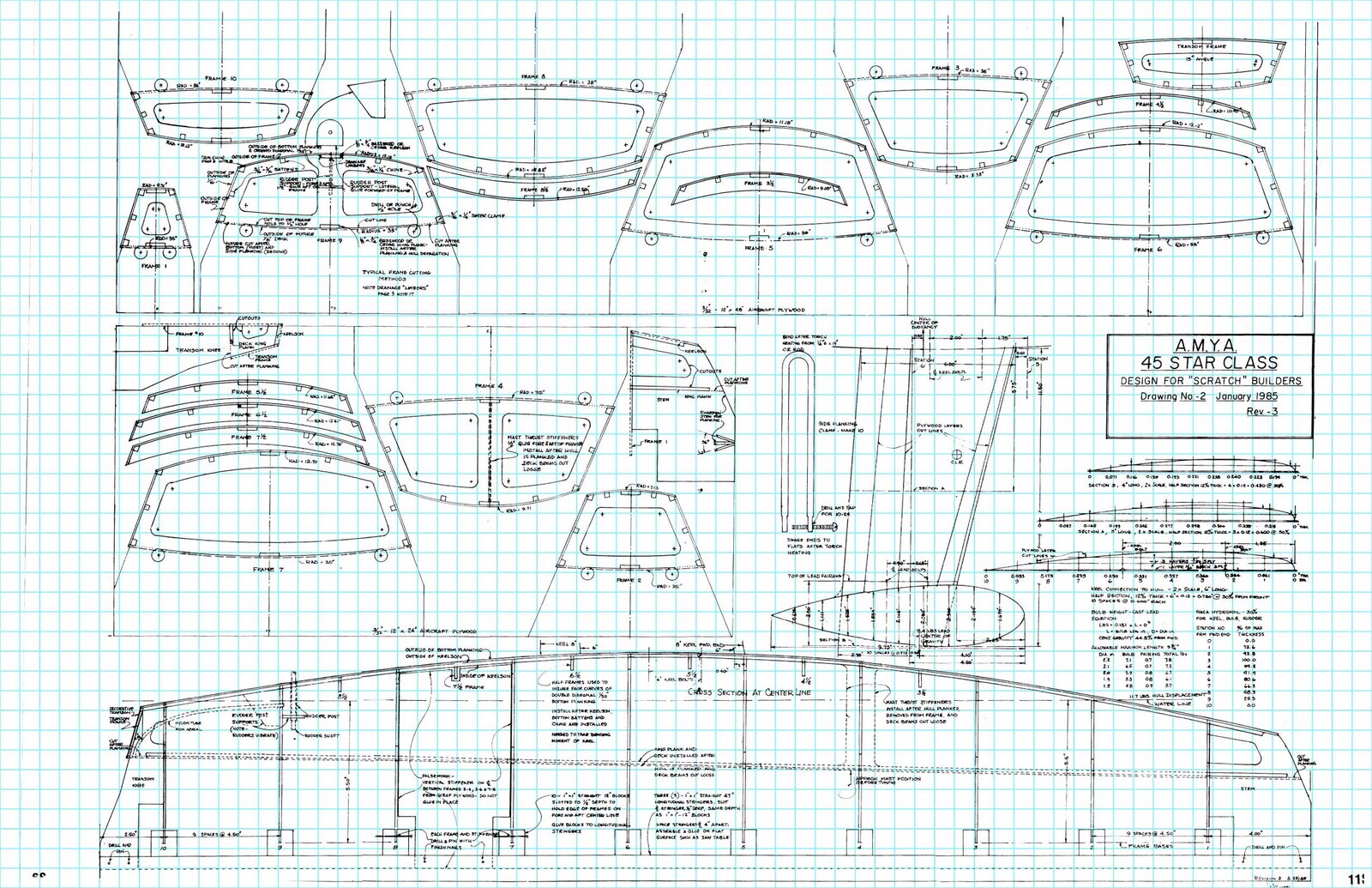
I ordered the Glen-L Waterlodge plans for just over a hundred bucks.  They arrived promptly.  I opened them with excitement and was not disappointed.  These are beautiful large detailed blueprints.  Gorgeous.

Even if I dont build a boat, I now have beautiful nautical art I can hang.


Do you find information about Boat Plans At Mystic Seaport are you looking for? If not, below may help you find more information about the Boat Plans At Mystic Seaport. Thank you for visiting, have a great day.
Read More..

Jumat, 19 Februari 2016

Boat Plans Canada


Boats are made of lots and lots of funny precision parts that all look more or less the same but are subtle different.  A bow skeg stringer end accidentally exchanged for a stern skeg stringer end and its all over.

The previous build day, in my excitement I threw together the dead simple building form, and assembled it wrong.  The building form is just made of 2x4s nailed together, but the boat members will be screwed and epoxied.  Theres no going back on wood parts epoxied together.  A serious error could mean having to start completely over on that member. 


So the previous build day was a lesson in the need for precision.  Before going further, I created labels for every piece of every member of the hull.  As I ripped pieces and then cut them to length, I stapled my sturdy cardboard labels directly on to the boards.


This way, when it came time to assemble, say, the starboard skeg stringer, I would only have to gather up all the pieces that said SKEG STRGR 1 (top, bottom, fore post, aft post, fore end, aft end) and bring them into the barn for assembly.


I also got a quad-ruled comp book and started taking detailed notes.  All the things youd normally scribble down on scratch paper as you were calculating angles and measurements and offsets went into the notebook.  All my little sketches of what pieces should look like before I cut them, lists of procedures, materials I needed to get, and a detailed journal of each day of work went into the comp book.


Along with a place in the barnyard to build the boat, Lawrence let us use an unused horse stall in the barn.  This made a perfect build office, a place to layout the plans, organize all our tools, and most importantly keep snacks and beer.


Having the right tool at hand when you need it, is not only convenient but can be critical during the stressful build process, especially when you are dealing with epoxy.  We spent time making sure that every tool had its own place.  This also had the benefit of making daily clean up more fun.  It felt good to do a lot of hard work and then have everything all neat and tidy at the end of the day.

Here Kai, one of my co-builders, in a goofy moment, models the first photo for our Little Shantyboat Pinup Calendar.  This also helps make boatbuilding not suck.

Do you find information about Boat Plans Canada are you looking for? If not, below may help you find more information about the Boat Plans Canada. Thank you for visiting, have a great day.
Read More..