Tampilkan postingan dengan label boatyards. Tampilkan semua postingan

Minggu, 20 Maret 2016

Boat Blind Plans


LIKE MOST PEOPLE who have gotten used to traveling slowly in sailboats, I have often been angered by the irresponsibility of powerboaters who drag large, dangerous wakes behind them.

Let me say straight away that this is not a rant against powerboaters per se. There are considerate powerboaters and inconsiderate ones, and while I’m quite sure the former vastly outnumber the latter, the memories of the latter are what stick in my mind.

I’ll never forget something Robert Hale, of Seattle, once wrote. He was the former respected publisher of the annual Waggoner Cruising Guide for the waters of the Pacific Northwest of the USA. In the 2003 edition he wrote:

“Shortly after going from sail to power, I came to understand what I call the First Rule of Powerboating: Never Look Back.

“Because, if we powerboat skippers would look back, we would be appalled at what we do to other boats.”

Coming from a powerboater, that was a very honest and refreshing statement. It actually inspired me to invent a curse for sailors to use when faced with enormous wakes that inconvenience other boats and even threaten to capsize or swamp smaller vessels.

It’s a curse that might help you to vent your fury harmlessly in circumstances where you might otherwise be tempted to reach for your rifle and let Nature take its course. This, in fact, is one of four examples in a chapter devoted to curses in my book How to Rename your Boat — and 19 Other Useful Ceremonies, Superstitions, Prayers, Rituals, and Curses.

This is what I wish for the powerboat wash-hogs, or PAFIs as I call them.*

A CURSE FOR LEAVING A LARGE WAKE

Woe to you, thou beslubbering speedhog!

May your filters choke and your injectors freeze.

May every ill befalling a boat bring you to your knees.

May you run out of whisky, and ice cubes, too.

May there be no more pleasure for you or your crew.

May all your bronze tarnish and your varnish all flake.

May your batteries die and your propellers shake.

May your anchors drag and your bilges overflow.

May you rot in a hell where they make you go slow.

Curse you! Curse you! My curse be upon you wherever you go!

*Power Assisted F...ing Idiots 

Today’s Thought

I sent down to the rum mill on the corner and hired an artist by the week to sit up nights and curse that stranger.

— Mark Twain, A Mysterious Visit

Tailpiece

It’s too bad that by the time we get old enough not to care what anybody says about us, nobody’s saying anything about us.

Do you find information about Boat Blind Plans are you looking for? If not, below may help you find more information about the Boat Blind Plans. Thank you for visiting, have a great day.
Read More..

Jumat, 11 Maret 2016

Kayak Boat Plans


I WAS ONCE introduced to a man who sailed a Wayfarer 16-foot dinghy among the islands of the Salish Sea, here in the Pacific Northwest. He was very modest when he learned I’d crossed oceans. “I only take little voyages, and never out of sight of land,” he said.

I assured him that small, gentle voyages can generate as much joy and satisfaction as long adventurous ones.

The man or woman who gingerly sails a dinghy along a friendly shore is no less worthy of our respect than the sailor who braves the open ocean. 

We all have our own areas of anxiety and doubt in our own abilities, and when we conquer our fears it is just as much a triumph to cross the bay as it is for someone of sterner nature to cross an ocean.

And yet, human nature being what it is, we tend to judge other sailors by the size of their boats and how far they’ve traveled: their most distant ports, and the length of their voyages.

Now it is true that sailors who cross oceans in small boats perform impressive feats of seamanship because they sail the same seas as big commercial ships that have large crews specializing in the various skills needed to move people and cargoes across oceans. Sailboat sailors are their own cooks and navigators. They are their own engineers and riggers. They handle the sails and anchors and electrical circuits. And they face exactly the same hazards as large ships, including the storms, the rocks, and even pirates.

Yet, at the same time, to take a small boat across a body of water of any size is no small feat. To each his own goals and ambitions. We all set our own limits, and who can gainsay our individual achievements? What we all seek deep down is a feeling of ability, of achievement, of confidence. And sailing a small boat on a small voyage often does generate the confidence we need to deal with the greater troubles the world constantly throws at us.

Seamanship is as much a set of the mind as anything else. And small, simple boats can afford pleasure and gratification out of all proportion to their cost. We are the only ones fit to judge our seamanship. We challenge ourselves, we feel fear, and sometimes we get more fear than we bargained for, but we learn and we gain confidence, and are not as frightened quite as much the next time. And there always is a next time for those who challenge themselves.

Today’s Thought
Keep your fears to yourself, but share your courage.
— R. L. Stevenson

Tailpiece
The greatest area of unemployment in the world today is the region just north of the ear.


Do you find information about Kayak Boat Plans are you looking for? If not, below may help you find more information about the Kayak Boat Plans. Thank you for visiting, have a great day.
Read More..

Minggu, 06 Maret 2016

Canoe Boat Plans


A READER IN OHIO is having wife trouble. “Old Salt” says his wife complains that cruising on their sailboat is hazardous to their health because Old Salt never washes, and he wears the same clothes day in and day out. “But I remember that you once wrote a column about sailing hygiene,” says Old Salt. “Would it be a good idea to repeat it, for my wife’s benefit?”

Oh my goodness yes, Old Salt. It would be a wonderful idea. It saves me having to think of a new idea.

So here it is, five years old now, but still pretty much up-to-date, I believe:

Cruising hygiene

DO MEN CHANGE THEIR UNDERPANTS while cruising? A young woman reader in Dade County, Florida, wants to know. Geraldine says her new boyfriend has invited her on a six-week cruise to the Bahamas on his Cape Dory 25D sailboat. She has not sailed before, but she is fine with everything — except what she suspects might be a hygiene problem.

Do men on small boats change their socks? she asks.

Do they EVER wash ANY clothes?

Do they wash their hands after going to the head?

Do men brush their teeth morning and night?

Do they ever change the bed sheets?

Do they even HAVE bed sheets?

Well, Geraldine, you have poked your little stick into a big hornets’ nest here. Obviously I can’t answer for all cruising men, and as far as I know nobody has conducted research into this subject. But if it’s any comfort, as far as I know, not many cruising men die from bubonic plague or big bad germs in the gut.

I can only tell you of my own experience of long-term cruising and the answer to your first question is yes, men do change their underpants every day, one pair a day for seven days. Then, on the eighth day they start over. The theory is that the underpants have aired for a whole week, which is plenty of time for any germs to jump off and go somewhere else.   

Socks? Mostly we don’t wear socks, but even if we do, we only have two pairs. They’re good for seven days before rotation. We don’t walk anywhere, you see, so there’s no sweat or anything objectionable. You’ll notice that no men ever complain about other men’s socks.

Washing clothes? Well that depends on the availability of fresh water (very rare) and a place to do the washing (also rare). It depends on the weather and the amount of rail space available for drying. It depends when you can find the time, when you have a whole lot of other things to do (such as steering around rocks and anchoring and reefing and navigation) that are a lot more important than washing clothes. So, in short, the answer is ... well I have known one or two men who have washed some cruising clothes, so it’s not completely unknown.

As for washing hands after using the head, I have to assure you that it’s a distinct possibility in a boat like yours that has a wash basin in the head. Of course, most men won’t use it for fear of running out of fresh water, but at least there is a definite possibility; and that surely must cut down on the odds of disease erupting.

Do men brush their teeth morning and night? Geraldine, I think it is a scientifically accepted fact that as long as you break up the plaque every 24 hours, one brushing a day is sufficient. And, by happy discovery, a large body of cruising men has found that swilling the mouth with gin just before bed is equally as efficient in the prevention of tooth decay as is brushing with toothpaste.

As for bed sheets, well that depends on the sissy factor. Real men don’t use bed sheets. They use rough, hairy, woolen blankets or sleeping bags designed for Mt. Everest. I confess that I have a sort of sheet for my sleeping bag, a removable cotton liner, but after you’ve slept in it for two months straight I’ve noticed that it seems to grow little lumps inside like a real woolen blanket, so it’s really quite macho and not as pooftah as you might think.

Geraldine, you can spend too much time worrying about hygiene. There are places in Europe where they only take a bath once a week. There are places in the Sahara where they never bathe. It’s true that their average lifespan is 23 years, but nobody has ever actually proved it’s because of lack of bathing.

On the whole, you will find that the cruising life is very healthy. Strong sunshine and salt water are very good at killing germs. And those few germs that don’t die immediately will surely succumb when they eventually drift down and get swallowed up by that seething, squirming mass of micro-wildlife in your bilge.

Go for it, Geraldine. Go for the beautiful beaches and the glorious crystal-clear water; go for the romantic tropical nights and the soft trade winds brushing the coconut palms in silver moonshine. And let hygiene take its chance, as Nature intended.

Today’s Thought
A man’s own observation, what he finds good of and what he finds hurt of, is the best physic to preserve health.
— Bacon, Essays: Of Regimen of Health

Tailpiece
A yacht club barman I know has invented a drink called the Block and Tackle. It’s one third whiskey, one third brandy, and one third vodka. After two of those you’re ready to run around the block and tackle anything.

(Drop by every Monday, Wednesday, Friday, for a new Mainly about Boats column.)


Do you find information about Canoe Boat Plans are you looking for? If not, below may help you find more information about the Canoe Boat Plans. Thank you for visiting, have a great day.
Read More..

Jumat, 04 Maret 2016

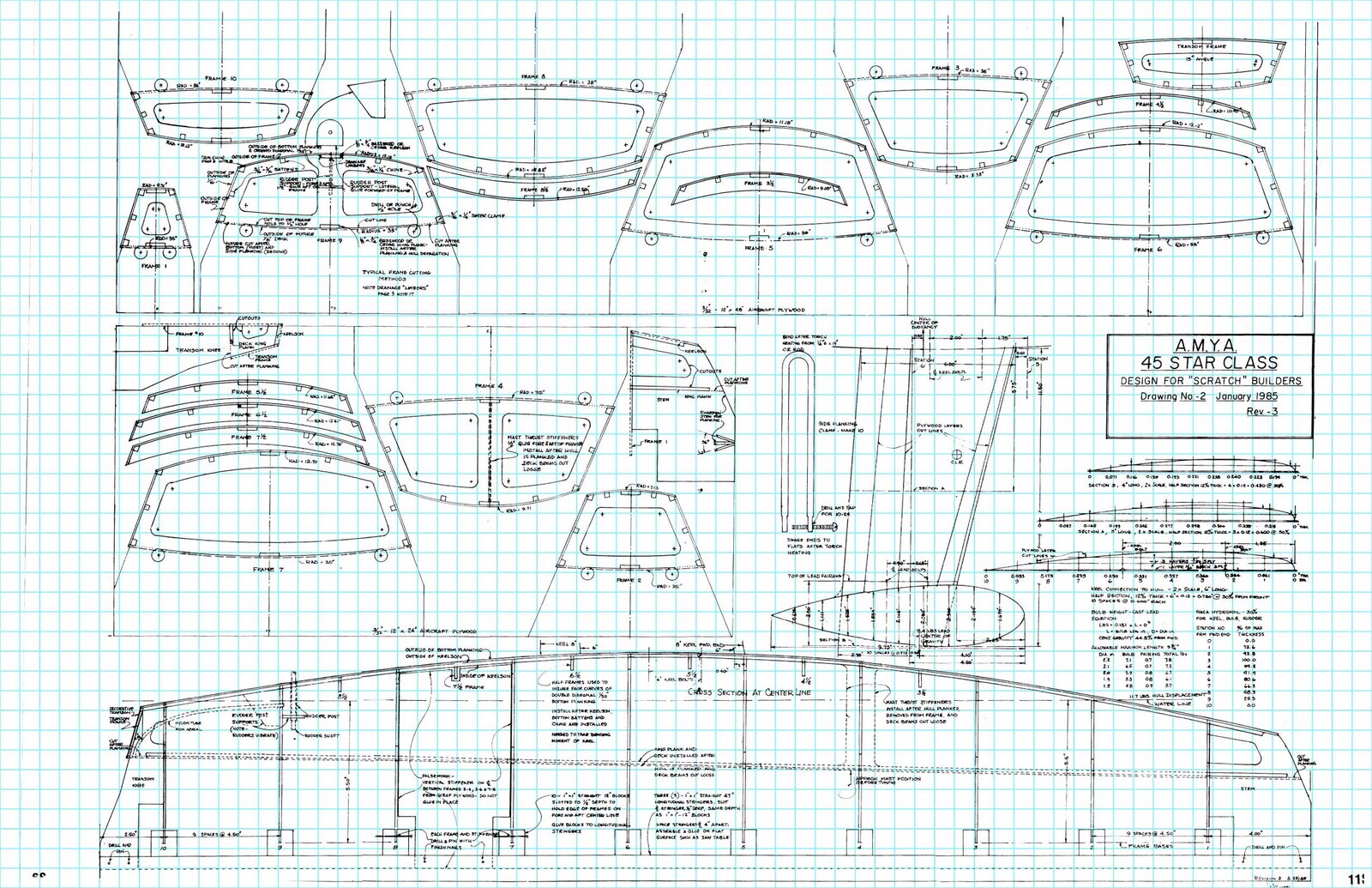
Plywood Boat Plans


IT’S ALMOST EXACTLY 100 years since one of the most famous American small-boat architects designed and built a wooden boat called  Cabrilla. William Atkin and his boyhood friend Cottrell Wheeler were the owners of a small boatyard on Long Island, New York, and Cabrilla was the largest boat they built there. She was a high-speed express cruiser, 115 feet in overall length.

But one of the most interesting things about her was the fact that young Atkin and Wheeler themselves designed the twin V-8 gasoline engines that powered her. Not only that: they built the engines, too, and installed them of course.

Atkin said later in his book Of Yachts and Men:  “Reviewing those days . . . I am astonished at the work we undertook and produced. The design work on Cabrilla was no small item.” This, naturally, was long before the days of computers, or even calculators, and all the work was done with pencil, paper, drafting ink, and the human brain.

Atkin described those engines as “big fellows of more than usual interest.” Each was of V-type with eight cylinders. The cylinder bore was 8 inches and the stroke 14 inches. Each bank of four cylinders was cast en bloc and, to insure perfectly even cylinder walls, was cast without the water-cooling jackets; the jackets were fitted to the cylinder blocks after all the machine work was completed.

In his book Atkin says: “The crankshaft was a steel casting and turned on Hess-Bright ball bearings, three bearings to each engine. To give some idea of the size of the crankshaft: the races of the bearings ran on balls having a diameter of 2 3/4 inches. The inlet and exhaust valve sets were made of heat-treated steel and were removable. The exhaust-valve stems were cooled with sodium. All the reciprocating valves were closed by positive cams rather than by compression springs. The crankcase was of skeleton form, cast of vanadium bronze and had 1/16th-inch-thick Tobin bronze plates to cover the openings.”

Atkin used outside contractors to manufacture several parts of the engine to his designs, but hundreds of other parts were made and assembled in his own boatyard basement.

“Yes, shipmates, Cabrilla’s engines were big fellows,” Atkin reflects, “and when, in these later years, Cottrell and I contemplate the fading past, we marvel at our youthful courage in tackling this job, which then seemed very simple, but which if attempted now would embarrass the engineering department of a large corporation.

“Cottrell designed all the mechanical and electric fittings for the hull, the disk clutches and reverse gears, and supervised their construction. The design of the engines was my contribution to the work then in hand. All this we accomplished within nine months and without the assistance of draftsmen or additional help.

“Fortunately, Cabrilla was designed before the days of expeditors, industrial efficiency, inspectors, personnel managers, safety engineers and all the other complicated and expensive claptrap of present-day production confusion. If we had had the fellowship of today’s industrial top-heaviness and discord, the yacht might never have been launched at all.”

Today’s Thought

Often ornateness goes with greatness;

Oftener felicity comes of simplicity.

William Watson, Art Maxims

Tailpiece

“Man, I never realized how short of living space the world has become.”

“What makes you say that?”

“Well, I came home early last evening and found a strange man living in my wife’s wardrobe.”

(Drop by every Monday, Wednesday, Friday for a new Mainly about Boats column.)


Do you find information about Plywood Boat Plans are you looking for? If not, below may help you find more information about the Plywood Boat Plans. Thank you for visiting, have a great day.
Read More..